
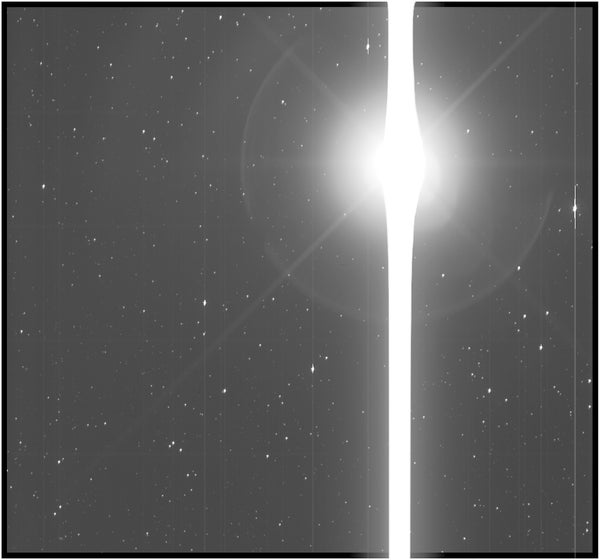
This is what Earth looks like through a planet hunter's eyes.
Our home planet blazes like a cosmic lighthouse in a photo taken by NASA's Kepler space telescope, which has discovered more than 2,500 alien worlds to date.
"Captured on Dec. 10, 2017, after the spacecraft adjusted its telescope to a new field of view, Earth's reflection as it slipped past was so extraordinarily bright that it created a saber-like saturation bleed across the instrument's sensors, obscuring the neighboring moon," NASA officials wrote in a description of the photo, which was released Wednesday (March 7)—the ninth anniversary of Kepler's launch. [10 Amazing Photos of Earth from Space]
On supporting science journalism
If you're enjoying this article, consider supporting our award-winning journalism by subscribing. By purchasing a subscription you are helping to ensure the future of impactful stories about the discoveries and ideas shaping our world today.
Earth appears so bright because Kepler's light-sensing photometer is exquisitely sensitive. The instrument was designed to detect the tiny brightness dips caused when exoplanets cross their host stars' faces from Kepler's perspective.
The spacecraft first did this work while staring at about 150,000 stars simultaneously. But this initial mission came to an end in May 2013, when the second of Kepler's four orientation-maintaining reaction wheels failed, robbing the telescope of its precision pointing ability.
Mission managers soon figured out a way to stabilize Kepler using sunlight pressure, however, and Kepler embarked on a new mission called K2. During K2, Kepler continues hunting for planets on a more limited basis, and it's also observing a variety of other celestial objects and phenomena.
Kepler orbits the sun, a bit behind Earth. At the time the newly released photo was taken, the spacecraft was about 94 million miles (151 million kilometers) from our planet, NASA officials said.
A new planet hunter will soon join Kepler in the final frontier. NASA's Transiting Exoplanet Survey Satellite (TESS) is scheduled to launch on April 16, on a mission to hunt for alien worlds circling stars in the sun's neighborhood. As its name suggest, TESS will use the "transit" technique—the same planet-hunting method Kepler employs.
Some of the planets found by TESS will likely be studied in detail by NASA's $8.9 billion James Webb Space Telescope, which is due to lift off in 2019.
EDITOR'S RECOMMENDATIONS
1,000 Alien Planets! NASA's Kepler Space Telescope Hits Big Milestone
How Eclipses Reveal Information About Alien Worlds, Light-Years Away
Copyright 2017 LiveScience.com, a Purch company. All rights reserved. This material may not be published, broadcast, rewritten or redistributed.