
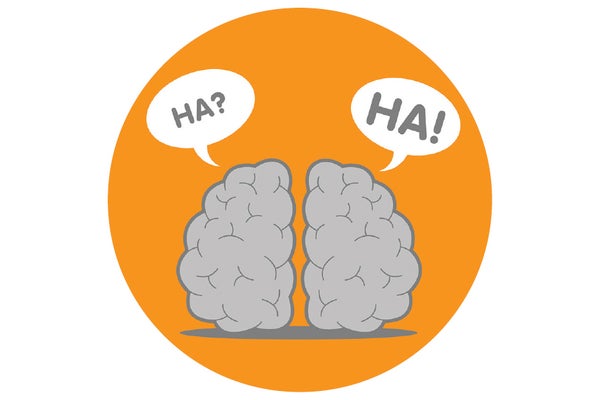
Puns are divisive in comedy. Critics groan that they are the “lowest form of wit,” a quote attributed to various writers. Others—including Shakespeare—pun with abandon. The brain itself seems divided over puns, according to a recent study published in Laterality: Asymmetries of Body, Brain and Cognition. The results suggest the left and right hemispheres play different roles in processing puns, ultimately requiring communication between them for the joke to land.
To observe how the brain handles this type of humor, researchers at the University of Windsor in Ontario presented study participants with a word relating to a pun in either the left or right visual field (which corresponds to the right or left brain hemisphere, respectively). They then analyzed a subject's reaction time in each situation to determine which hemisphere was dominant. “The left hemisphere is the linguistic hemisphere, so it's the one that processes most of the language aspects of the pun, with the right hemisphere kicking in a bit later” to reveal the word's dual meanings, explains Lori Buchanan, a psychology professor and co-author of the study.
This interaction enables us to “get” the joke because puns, as a form of word play, complete humor's basic formula: expectation plus incongruity equals laughter. In puns—where words have multiple, ambiguous meanings—the sentence context primes us to interpret a word in a specific way, an operation that occurs in the left hemisphere. Humor emerges when the right hemisphere subsequently clues us in to the word's other, unanticipated meaning, triggering what Buchanan calls a “surprise reinterpretation.”
On supporting science journalism
If you're enjoying this article, consider supporting our award-winning journalism by subscribing. By purchasing a subscription you are helping to ensure the future of impactful stories about the discoveries and ideas shaping our world today.
The study jibes with previous observations that brain injuries to the right hemisphere can be associated with humor deficits in some people, who understand a joke's meaning but “don't think things are funny anymore,” Buchanan says. She hopes this and future studies may lead to rehabilitative training to help such individuals get back their sense of humor. Bottom line: puns get on everyone's nerves.