
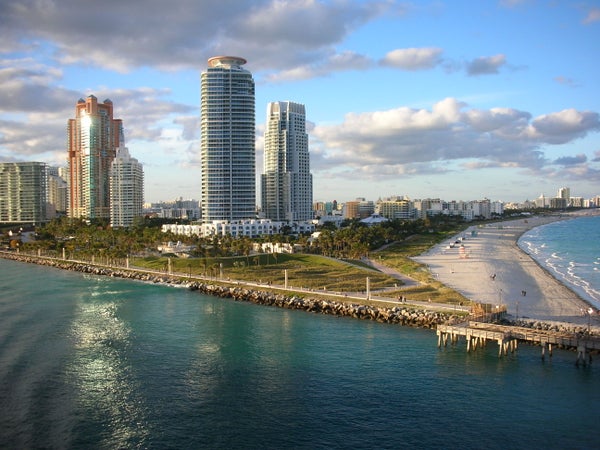
Health officials now believe the Zika virus is being transmitted by mosquitoes in parts of Miami Beach, a development that is expected to lead to a travel warning for one of the country’s best known travel destinations.
Roughly a handful of cases have cropped up that are believed to be linked to that part of the city, a health official who spoke on condition of anonymity told STAT.
Late Thursday afternoon health authorities were working to finalize the area that would be covered by a new travel advisory from the Centers for Disease Control and Prevention.
On supporting science journalism
If you're enjoying this article, consider supporting our award-winning journalism by subscribing. By purchasing a subscription you are helping to ensure the future of impactful stories about the discoveries and ideas shaping our world today.
Late last month, the CDC warned women who are pregnant to avoid a one-square-mile section of Wynwood, the Miami neighborhood where local transmission was first identified.
That marked the first time the Zika virus was confirmed to have been spreading in the United States, and the first time CDC had warned Americans against traveling to a part of the country to avoid contracting a disease.
Since then, 35 people who are believed to have been infected locally through the bites of mosquitoes have been identified. Many have been linked to Wynwood, either because they live, work, or have spent time there. But a number of cases have not had obvious ties to that part of the city.
The specter of ongoing Zika transmission in Miami Beach could have significant consequences for the Miami tourism industry, a key source of revenue for the state. The city saw a record 15.5 million visitors last year, according to the Greater Miami Convention & Visitors Bureau.
It could also have an impact outside Miami. Earlier this week, Texas reported a case of Zika that was contracted in Miami. And Taiwan reported a woman who had traveled to Miami came home infected.
Zika is transmitted mainly by Aedes aegypti mosquitoes, which are found throughout Florida and other states on the Gulf Coast. Although the virus generally causes only a mild illness — and often no symptoms at all — it can cause serious birth defects in fetuses when it infects pregnant women.
Miami Beach Commissioner Kristen Rosen Gonzalez said officials have yet to find a Zika-carrying mosquito.
“All we have right now are reported cases of people who are positive,” she said. “That being said, we’re working on mosquito control.”