
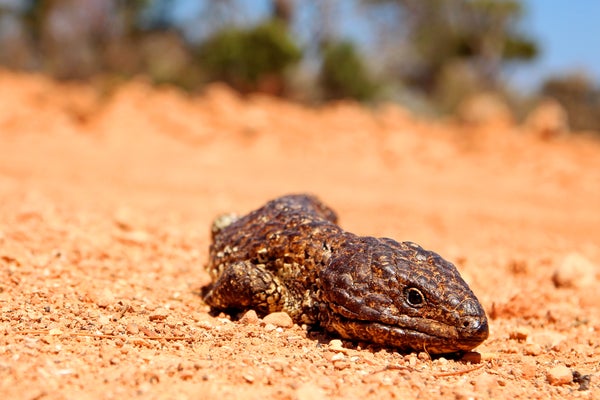
A burned lunch at the Audubon Zoo in New Orleans did more than just disappoint a hungry staffer. As soon as a smoke plume from the mishap drifted into their enclosure, Australian “sleepy lizards,” a type of skink, suddenly stopped whatever they were doing—they tensed, flicked their tongues, and began pacing their enclosure’s edges and digging in the substrate, frantic to escape. Other reptile species in the same room didn’t flinch.
The incident sparked a scientific hunch: perhaps the lizards, which happen to hail from particularly fire-prone regions, had evolved to recognize a blaze’s chemical cues.
To test this hypothesis, Chris Jolly, a conservation biologist at Macquarie University and Charles Darwin University, both in Australia, and his colleagues exposed 10 adult female sleepy lizards to individual puffs of smoke and water vapor and separately to recordings of crackling wildfires and white noise. The lizards fled in response to smoke but were unfazed by water vapor or either recording. The findings, published in Biology Letters, suggest these lizards rely on smell—not hearing—to detect fire at long range, unlike some other lizards, frogs and bats.
On supporting science journalism
If you're enjoying this article, consider supporting our award-winning journalism by subscribing. By purchasing a subscription you are helping to ensure the future of impactful stories about the discoveries and ideas shaping our world today.
This idea aligns with Australian sleepy lizards’ known use of scent to recognize partners, with whom they form lifelong pair-bonds, as well as to find food and detect predators. “Smoke also tends to travel ahead of the flames and cuts through background noise,” Jolly says, “making smell a more reliable early warning than sound in open, windy, noisy environments.”
Many of the lizards tested had probably never experienced wildfire; their capture site hadn’t burned in more than 50 years. Yet they still bolted when they sensed smoke, suggesting an innate adaptation. (The strong response was notable given the animals’ typical slow, deliberate movements, which Jolly assumes inspired the “sleepy lizard” moniker: “They’re rarely in a rush to do anything, except, apparently, to escape from fire!”)
Juli Pausas, a research scientist at the Spanish National Research Council, who was not involved in the study, says that although the sleepy lizards’ reaction to smoke could indeed represent adaptation to fire—something also seen in certain bats, possums and lizards—future studies will have to rule out other explanations such as a general aversion to toxic substances in smoke.
“Nevertheless, the paper contributes to the emerging recognition that certain animal behaviors may represent fire adaptations, a topic that has been underexplored until recently,” Pausas says. As fires intensify amid climate change, the paper’s authors say, these sensory skills could mean the difference between survival and death.