Space & PhysicsOctober 1, 1994
The Evolution of the Universe
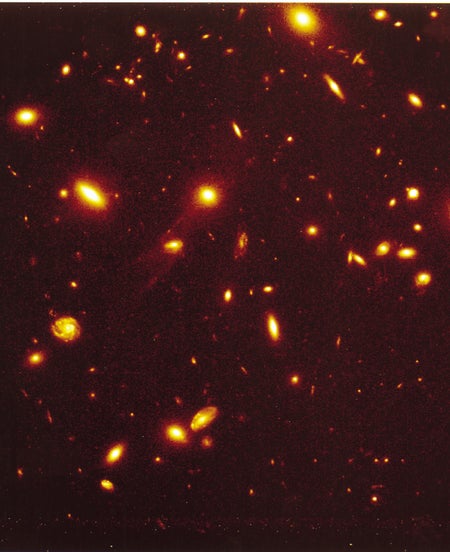
Some 15 billion years ago the universe emerged from a hot, dense sea of matter and energy. As the cosmos expanded and cooled, it spawned galaxies, stars, planets and life
The Evolution of the Universe
Some 15 billion years ago the universe emerged from a hot, dense sea of matter and energy. As the cosmos expanded and cooled, it spawned galaxies, stars, planets and life

Particle Accelerators Test Cosmological Theory
Is there a limit to the number of families of elementary particles? Debris from the big-bang origin of the universe suggests there is, and accelerators are reaching the energies required to confirm the limit
Did a Supernova Trigger the Formation of the Solar System?
Isotopes found in a few primitive meteorites are probably debris from a massive star that apparently exploded near the developing solar system about a million years before the meteorites formed
Will the Universe Expand Forever?
The recession of distant galaxies, the average density of matter, the age of the chemical elements and the abundance of deuterium together suggest that the expansion cannot be halted or reversed.
The Age of the Elements
Study of the fomation and spontaneous decay of radioactive nuclei can reveal when certain of the elements were created. From this information one can infer the age of the universe