Space & PhysicsAugust 4, 2017
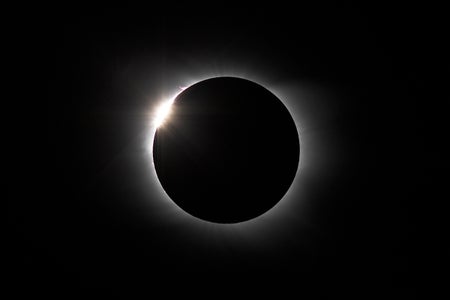
A Partial Eclipse Is Interesting; a Total Eclipse Is Mind-Blowing
Photos don’t do it justice—it’s perhaps the most spectacular natural phenomenon you’ll ever see
Edwin L. Turner is a professor of Astrophysical Sciences at Princeton University, an affiliate scientist at the Kavli Institute for the Physics and Mathematics of the Universe at the University of Tokyo, a visiting member in the Program in Interdisciplinary Studies at the Institute for Advanced Study in Princeton, and a co-founding Board of Directors member of YHouse, Inc. He has experienced total solar eclipses in 1970 on an island off the Massachusetts coast, in 2006 in the Egyptian desert, and in 2009 from a cruise ship in the Pacific Ocean--but missed one due to clouds in 1999 in southern Germany. He hopes to view the 21 August 2017 eclipse from a location near Jackson Hole, Wyoming.
A Partial Eclipse Is Interesting; a Total Eclipse Is Mind-Blowing
Photos don’t do it justice—it’s perhaps the most spectacular natural phenomenon you’ll ever see
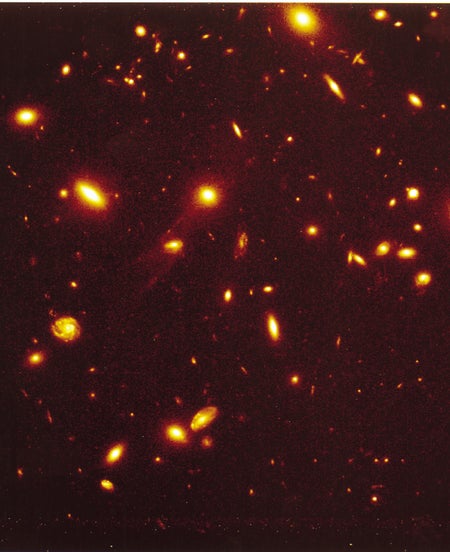
The Evolution of the Universe
Some 15 billion years ago the universe emerged from a hot, dense sea of matter and energy. As the cosmos expanded and cooled, it spawned galaxies, stars, planets and life

Gravitational Lenses
These cosmic flukes offer a unique window on the secrets of the universe. Systematic searches now under way are designed to realize the scientific promise of the objects