
The SciencesMay 28, 2015
A Few of My Favorite Spaces: The Topologist's Sine Curve
The topologist's sine curve is a classic example of a space that is connected but not path connected: you can see the finish line, but you can't get there from here.
Evelyn Lamb is a freelance math and science writer based in Salt Lake City, Utah.
A Few of My Favorite Spaces: The Topologist's Sine Curve
The topologist's sine curve is a classic example of a space that is connected but not path connected: you can see the finish line, but you can't get there from here.
Proof, Pudding, and Pi: Math Books that Will Make You Hungry
Need some summer reading? How to Bake Pi by Eugenia Cheng and The Proof and the Pudding by Jim Henle show us that math and cooking have more in common than you might think.
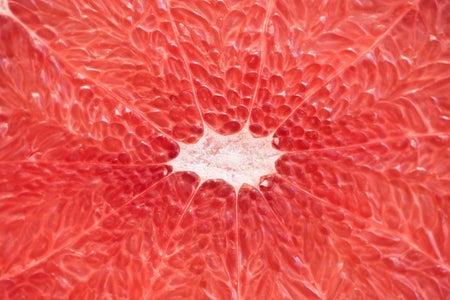
Grapefruit Math
Spherical geometry: it's part of this complete breakfast.
A Few of My Favorite Spaces: Fat Cantor Sets
Last month, I wrote about the Cantor set, a mathematical space that is an interesting mix of small and large. It's small in the sense that its length is 0.
Mathematics, Live: A Conversation with Katie Steckles and Laura Taalman
Two math communicators talk about how they got interested in math and how they share their enthusiasm with others
In Praise of Fractals and Poetry
For Math Poetry Month, a poem about fractals
Lambert on Love and Hate in Geometry
The history of hyperbolic geometry is filled with hyperbolic quotes, and I came across a beautiful one earlier this semester in my math history class.
The Cantor Function: Angel or Devil?
When you're looking at it, it just stays there, constant and still. But if you turn your back for just an instant at a point in the Cantor set, the function grows impossibly quickly.

A Few of My Favorite Spaces: The Cantor Set
The Cantor set is huge, but there isn't very much there.
What’s So Great about Continued Fractions?
Continued fractions are objectively the best in approximation technology
Don’t Recite Digits to Celebrate Pi. Recite Its Continued Fraction Instead.
Transcend decimals as you celebrate this transcendental number
Uber, but for Topological Spaces
So it's cold and rainy, and you're up a little too late trying to figure out why that one pesky assumption is necessary in a theorem. Wouldn't it be nice if you could just order up a space that was path connected but not locally connected?
Things to Make and Do in the Fourth Dimension (Book Review)
Sometimes you want to learn a “new” multiplication algorithm from a general interest math book, sometimes you want to learn why voting systems are doomed to imperfection, and sometimes you just want to play with numbers, patterns, and pictures.
The Media and the Genius Myth
We should not let portrayals of "genius" mathematicians keep the rest of us out of mathematics.

Understand the Measles Outbreak with this One Weird Number
The basic reproduction number and why it matters
Learn to Count like an Egyptian
Last semester, I began my math history class with some Babylonian arithmetic. The mathematics we were doing was easy—multiplying and adding numbers, solving quadratic equations by completing the square—but the base 60 system and the lack of a true zero made those basic operations challenging for my students.
Mathematics, Live: A Conversation with Amal Fahad and Rasha Osman, Part II
I had the pleasure of attending the 2nd annual Heidelberg Laureate Forum in September. Modeled after the Lindau Nobel Laureate Meetings, it brings together recipients of prestigious awards in mathematics and computer science and young researchers in those areas.
Mathematics, Live: A Conversation with Amal Fahad and Rasha Osman, Part I
I had the pleasure of attending the 2nd annual Heidelberg Laureate Forum in September. Modeled after the Lindau Nobel Laureate Meetings, it brings together recipients of prestigious awards in mathematics and computer science and young researchers in those areas.
12 Things I Had Way Too Much Fun Writing This Year
It’s the season for family, hot chocolate, and year-in-review lists. Guess which one this is! Roots of Unity has been around for two years now, and I’m so glad I have a place to share some of the weird and wonderful math I think about.
What We Talk about When We Talk about Holes
For Halloween, I wrote about a very scary topic: higher homotopy groups. Homotopy is an idea in topology, the field of math concerned with properties of shapes that stay the same no matter how you squish or stretch them, as long as you don’t tear them or glue things together.
Online Game Crowd-Sources Theorems
Now is your chance to prove some theorems without knowing what they mean! Chris Staecker, a mathematician at Fairfield University, created the game Nice Neighbors to get crowd-sourced solutions to problems from a field called digital topology.
Seeing Music: What Does the Missing Fundamental Look Like?
I wrote a post yesterday about the missing fundamental effect. It’s a startling auditory illusion in which your brain hears a note that is lower than any of the notes that are actually playing.
Your Telephone Is Lying to You About Sounds
Telephones lie about sounds because odd numbers aren't even. Once again with those integers and sound perception! Telephones can only pick up frequencies above 300 or 400 Hertz (cycles per second, also called Hz), but most adults’ speaking voices are lower than 300 Hz (approximately the D above middle C).
The Saddest Thing I Know about the Integers
We can't tune pianos because prime numbers