
Space & PhysicsNovember 12, 2020
A Cosmic Video Miniseries to Ponder Gravity, the Universe and Everything
Earthly matters got you stressed? Here is an opportunity to elevate your mind above the terrestrial din with three cosmic questions
Jared Kaplan is an associate professor in the department of physics and astronomy at Johns Hopkins University.
A Cosmic Video Miniseries to Ponder Gravity, the Universe and Everything
Earthly matters got you stressed? Here is an opportunity to elevate your mind above the terrestrial din with three cosmic questions
To Understand Gravity, Toss a Hard Drive into a Black Hole
We probably think we know gravity pretty well. After all, we have more conscious experience with this fundamental force than with any of the others (electromagnetism and the weak and strong nuclear forces). But even though physicists have been studying gravity for hundreds of years, it remains a source of mystery.
In our video Why Is Gravity Different? We explore why this force is so perplexing and why it remains difficult to understand how Einstein’s general theory of relativity (which covers gravity) fits together with quantum mechanics.
Gravity is extraordinarily weak and nearly impossible to study directly at the quantum level. We cannot scrutinize it using particle accelerators like we can with the other forces, so we need other ways to get at quantum gravity.
Enter black holes. In a paper in the early 1970s the late physicist Jacob Bekenstein investigated the question of what happens to entropy—a measure of disorder, or randomness, in a system—when matter succumbs to a black hole’s massive gravitational pull and falls through its event horizon.
Bekenstein noted that the matter’s entropy seems to disappear inside the black hole. Yet this would violate the second law of thermodynamics, which states two things: information cannot be destroyed, and entropy can only increase. Thus the entropy of the black hole must compensate for the loss. Bekenstein argued that this black hole entropy must not be proportional to the black hole’s volume, but to the area of its event horizon.
If we are describing the contents of black holes in terms of area instead of volume, we should think about laws of physics in terms of area as well. This would mean a theory of everything (gravity included) should be able to play out in fewer than three spacetime dimensions.
Now let’s imagine the information that describes the state of the entire universe—all stored on a single hard drive. And then throw that hard drive into a black hole. The stored information cannot be lost, so it must be contained in the surface area of the black hole (albeit scrambled).
This scenario leads to a dramatically new way of thinking in which the universe could effectively be a hologram, a seemingly 3-D object that is actually just a projection from a 2-D surface. Our ostensibly three-dimensional experience of the world would then be an illusion, convincingly generated by a fundamentally lower-dimensional reality.
Maybe we’re all just paper-thin cutouts drifting in gravity’s cosmic breeze.
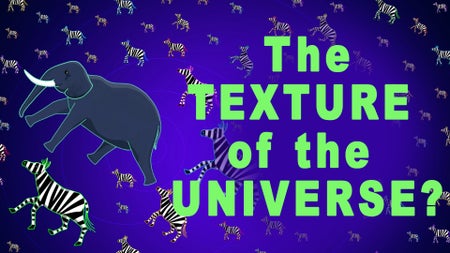
The Big Bang, Zebras and the Texture of Our Universe
What do zebras have to do with the structure of the cosmos? Imagine a single zebra in your mind. With twitching ears, tufted hair, and a visual interference pattern wrapped over muscle and skin, the animal has its own contours, which are easy to make out up close. But get a large group of zebras together (a dazzle, by definition), and the individuals blend and meld into a seemingly homogeneous sea of heads, hoofs and stripes, especially when viewed from a great distance. The matter in the universe, it seems, dazzles in much the same way.
In this video, How the Big Bang Governs the Texture of Our Universe, we explore the concept of cosmic inhomogeneities—using zebras as an analogy for clumps of matter scattered throughout the universe. Animator Lottie Kingslake depicts these whimsical and familiar characters as they graze and form larger and larger groups similarly to how matter is pulled together in galaxies. We were inspired by the color palette of Marylyn Dintenfass’s paintings, which make up the backdrop in the live-action portion of the video.
This visual rendering takes up a fundamental question about the texture of space: Is it smooth or bumpy? The answer is that it is both. It is homogeneous, or smooth, when viewed from vast distances but inhomogeneous, or bumpy, at the scale of planets and galaxies. This difference in texture gives us hints about our universe’s earliest history and even lets us characterize how dark matter is distributed.
But what exactly does it mean for the universe to be textured as it is? Empty space is smooth because there is no matter to alter the equilibrium of the universe. Moments after the big bang, there was a period of inflation, in which the universe expanded exponentially. At this point, the universe was almost perfectly smooth—because although it was devoid of stars and galaxies (the first atoms did not form until about 380,000 years after the big bang), there were tiny quantum ripples in spacetime.
Over time, these tiny quantum fluctuations were amplified by gravity. Clumps and voids formed, creating a bumpy texture on relatively small scales. As gravity pulled the clumps together, they collapsed into themselves to form stars, planets and galaxies—and inhomogeneity gradually increased over cosmological time.
Our universe remains smooth, or homogeneous, over very long distances, where gravitational collapse does not hold sway. But if you zoom way out, all of the matter and energy in the cosmos appears evenly distributed.
That’s a little mental roughage to think about the next time you find yourself at the zoo.
Apple-Sized Stars, a Potato-Shaped Earth and the Force That Creates Our Reality
Life’s up and downs may seem as inevitable as gravity, but somehow 2020 feels worse than usual. Just as a thought experiment, what if this year actually did get so weird that it even ushered in a change in how gravity affects our material universe?
In the video Did the Universe Have to Be the Way That It Is? we examine what our universe—and more specifically, our lives—might look like with some tweaks to the physics responsible for the world as we know it.
If gravity were just a little stronger in our own three-dimensional world, the curvature of spacetime would be greater, and matter could more easily collapse in on itself. This arrangement would make stars, galaxies and planets extremely diminutive, compared with the ones in our reality. Not only would we have less space on Earth, but our sun would deplete its nuclear fuel much more rapidly—meaning that evolution, and life itself, would be greatly curtailed.
If gravity were weaker, Earth would be gigantic, and it might be oddly shaped like some asteroids—or a potato. And rather than walking on the surface of our planet, we might find ourselves, say, jumping to grab a rebound in a basketball game, only to accidentally end up in the upper atmosphere or orbiting the globe as a tiny human space station.
What if we weren’t three-dimensional at all? (Imagine people as paper cutouts.) If we lived in two dimensions, gravity would act very differently. Although we would still have the spacetime curvature noted in Einstein’s general theory of relativity, such curvature would no longer produce gravitational forces. For this sort of flattened universe, we could instead have “scalar gravity,” in which Newton’s description of gravity would have been the final word, and black holes would be relegated to science fiction.
Thankfully, even though 2020 seems topsy-turvy, we still have gravity to keep us grounded.