
TechnologyNovember 1, 2001
Current Safety-- Working Knowledge on Ground Fault Circuit Interrupters
Mark Fischetti was a senior editor at Scientific American for nearly 20 years and covered sustainability issues, including climate, environment, energy, and more. He assigned and edited feature articles and news by journalists and scientists and also wrote in those formats. He was founding managing editor of two spin-off magazines: Scientific American Mind and Scientific American Earth 3.0. His 2001 article “Drowning New Orleans” predicted the widespread disaster that a storm like Hurricane Katrina would impose on the city. Fischetti has written as a freelancer for the New York Times, Sports Illustrated, Smithsonian and many other outlets. He co-authored the book Weaving the Web with Tim Berners-Lee, inventor of the World Wide Web, which tells the real story of how the Web was created. He also co-authored The New Killer Diseases with microbiologist Elinor Levy. Fischetti has a physics degree and has twice served as Attaway Fellow in Civic Culture at Centenary College of Louisiana, which awarded him an honorary doctorate. In 2021 he received the American Geophysical Union’s Robert C. Cowen Award for Sustained Achievement in Science Journalism. He has appeared on NBC’s Meet the Press, CNN, the History Channel, NPR News and many radio stations.
Current Safety-- Working Knowledge on Ground Fault Circuit Interrupters
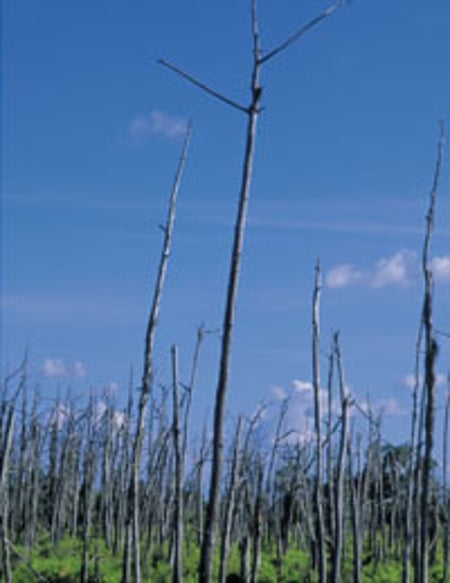
Drowning New Orleans
A major hurricane could swamp New Orleans under 20 feet of water, killing thousands. Human activities along the Mississippi River have dramatically increased the risk, and now only massive reengineering of southeastern Louisiana can save the city
Mice and Men-- Working Knowledge on a Computer Mouse
Crank It Up!
Human-Powered-Electronics
Tan or Burn
Flight Control
Quick Scan
At Your Fingertips
Gotcha!
You're zipping along the highway. Suddenly you see the patrol car up ahead. You slam on the brakes. Too late--the radar gun already has a bead on you. You're busted.
Preparing for Battle
Every year influenza contributes to 20,000 deaths in the U.S. and perhaps millions worldwide. Learn how vaccines protect against it.
The Future of Digital Entertainment

Gas Vaccine
Bioengineered immunization could shield against nerve gas