In her new book Beloved Beasts: Fighting for Life in an Age of Extinction, science journalist Michelle Nijhuis looks into the past of the wildlife conservation field, warts and all, to try to chart its future.
It is a tale of sound: the song of a solitary whale that vocalizes at a unique frequency of 52 hertz, which no other whale—as the story goes—can seemingly understand.
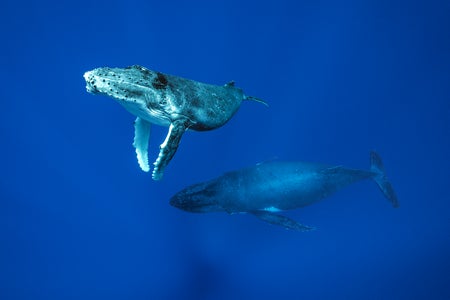
On Earth Day, Scientific American sits down with National Geographic underwater photographer Brian Skerry to talk about free diving with whales and filming the giant mammals within five meters or less.
“We have to get within a few meters of our subject to get good pictures,” Skerry says. “I can't use a 1,000-millimeter lens underwater. Also, the sun has to be out because I can’t light a whale underwater; they're too big.”
Skerry has been tracking whales, their hidden lives, their feeding rituals and hunting practices—strategies that differ dramatically from one whale pod to another—for nearly four decades. Both his new book Secrets of the Whales, released on April 6, and Disney+ series with the same title, a four-episode documentary that is narrated by Sigourney Weaver and premieres today, boast jaw-dropping moments.
A visual feast of magnificent scenery, the book and streaming series show humpback whales breaching the water surface to catch herring, orcas trailing ancient pathways, narwhals flicking their giant tusks to sting their prey and ghost-white beluga whales frolicking in shallow waters with their young—some of them only a few days old and still dragging around their umbilical cord.
The footage that Skerry filmed takes the audience on a tour of whale cultures across Antarctica, Norway, New Zealand, the Cook Islands, Alaska and other places. It tells stories of resilience, familial bonding and intimacy, generational knowledge sharing and deadly encounters—along with rich lives and complex behaviors that are reminiscent of humans and that were sometimes captured on camera for the first time.
“If we look at the ocean, through the lens of culture, these animals are doing so many things in many ways that mirror human culture,” Skerry says.
The Disney+ series, however, doesn’t only dwell on the magic and wonder of this world. It also warns against the effects of pollution and the ongoing climate emergency on a very delicate and interconnected marine ecosystem.
Secrets of the Whales was a perfect story to showcase both aspects, Skerry says, because it lives at the confluence of cutting-edge science and conservation. “I like to say, ‘It's not a conservation story,’” he adds. “And yet it could be the most important conservation story ever because if we can see these animals through that lens of culture, it changes how we perceive nature and our relation to it.”
It’s been 60 years, to the day, since Soviet cosmonaut Yuri Gagarin was the first human to travel to space in a tiny capsule attached to an R-7 ballistic missile, a powerful rocket originally designed to carry a three- to five-megaton nuclear warhead. In this new episode marking the 60th anniversary of this historic space flight—the first of its kind—Scientific American talks to Stephen Walker, an award-winning filmmaker, director and book author, about the daring launch that changed the course of human history and charted a map to the skies and beyond.
Walker discusses his new book Beyond: The Astonishing Story of the First Human to Leave Our Planet and Journey into Space, out today, and how Gagarin’s journey—an enormous mission that was fraught with danger and planned in complete secrecy—happened on the heels of a cold war between the U.S. and the Soviet Union and sparked a relentless space race between a rising superpower and an ailing one, respectively.
Walker, whose films have won an Emmy and a BAFTA, revisits the complex politics and pioneering science of this era from a fresh perspective. He talks about his hunt for eyewitnesses, decades after the event; how he uncovered never-before-seen footage of the space mission; and, most importantly, how he still managed to put the human story at the heart of a tale at the intersection of political rivalry, cutting-edge technology, and humankind’s ambition to conquer space and explore new frontiers.
Today on the Science Talk podcast, Noam Slonim of IBM Research speaks to Scientific American about an impressive feat of computer engineering: an AI-powered autonomous system that can engage in complex debate with humans over issues ranging from subsidizing preschool and the merit of space exploration to the pros and cons of genetic engineering.
In a new Nature paper, Slonim and his colleagues show that across 80 debate topics, Project Debater’s computational argument technology has performed very decently—with a human audience being the judge of that. “However, it is still somewhat inferior on average to the results obtained by expert human debaters,” Slonim says.
In a 2019 San Francisco showcase, the system went head-to-head with expert debater Harish Natarajan.
Beyond gaming, it’s rare to see humans and machines go against each other, let alone in an oratory competition.
Not unlike its human counterpart, the AI was given only 15 minutes to research the topic and prepare for the debate—rifling through thousands of gigabytes of information at record speed to form an opening statement and layer counterarguments that were later delivered through a robotic female voice, in fragments and with near perfect diction.
It couldn’t best Natarajan in San Francisco, but in a different debate, the system—co-led by Slonim and fellow IBM researcher Ranit Aharonov—has managed to change the stance of nine people in a debate on the use of telemedicine, essentially swaying the debate to its side and rebutting the argument of its opponent.
In other words, in this realm, humans still prevail.
But how do you build the architecture for a complex system like this? Is the AI capable of recognizing meaning or larger contexts in a debate? Can a system descended from Project Debater one day intervene in real-life social media arguments to quell misinformation or stir a debate in one direction or another, for better or worse? We answer these questions and more in the podcast.
You can call it the “revenge of the computer scientist.” An algorithm that made headlines for mastering the notoriously difficult Atari 2600 game Montezuma’s Revenge can now beat more games, achieving near perfect scores, and help robots explore real-world environments. Pakinam Amer reports.
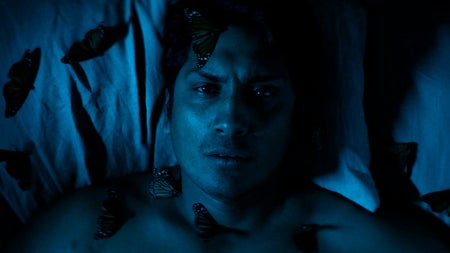
Today on the Science Talk podcast, Alexis Gambis, a New York University biologist and independent filmmaker, speaks about making Son of Monarchs,which won the 2021 Alfred P. Sloan Feature Film Prize at the Sundance Film Festival.
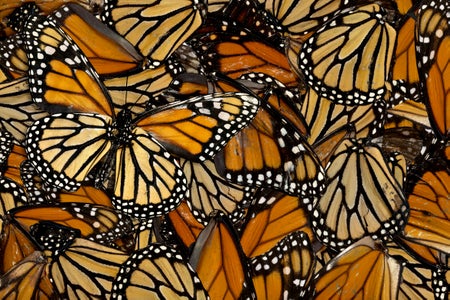
The film is about a Mexican scientist who studies the evolution of monarch butterfly wings. It is a cultural piece about the politics of immigration, spirituality and shifting identities.
Gambis talks about science beyond the lab bench, bringing CRISPR technology to the big screen and how he is usually given to bold, innovative features that focus on science or technology and that depict a scientist as a central character.
In one scene in Son of Monarchs, the main character stands in a rowdy bar and raises his glass to “CRISPR and the genetic revolution.” There are several allusions throughout the film to how gene editing fascinates and terrifies us. Evolutionary science is the thread that ties the human story together.
From script to screen, the scientist-director meditates on the long journey to the finish line, securing funding and how science’s big stories can be weaved into art.
Gambis has been running a science film festival for 13 years and making science films for longer. His next project, El Beso, is a plunge into the life and science-fiction writings of Santiago Ramón y Cajal, an early 20th-century Spanish neuroscientist who won the 1906 Nobel Prize in Physiology or Medicine.