
July 1, 2002
Who's Who
Can digital technology really prevent identity theft?
PAUL WALLICH is a staff writer for Scientific American.
Who's Who
Can digital technology really prevent identity theft?
Symmetry Breaking
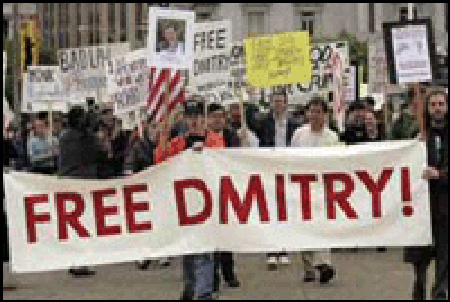
A Legal Job in One Country is Grounds For Arrest in Another

Completing the Circuit
Her research on integrated circuits advanced the Internet age by years. Now she finds herself revisiting her earliest, groundbreaking work in computers, which she long kept secret because, back then, she existed as a man
Wholesale Computation
Companies want to sell your computer¿s spare processing time. Are there buyers?
Unplugged but Unbowed
The Orwell Awards
In recognition of efforts to trample personal liberties on the electronic frontier
Who Wants Privacy?
Your First $20 Free!
To Err is Mechanical
How To Steal Millions in Chump Change
Your 0.002 Cent's Worth
The Best Things in Cyberspace Are Free
This is not a Hoax!
Look for the Union Label
New analysis of economic data shows that unionization could maximize productivity
Parental Discretion Advised
Cracking the U.S. Code
The 1996 Nobel Prizes in Science
The Royal Swedish Academy of Sciences has again recognized four sets of researchers for their outstanding contributions. Here is a look at the work behind these achievements in chemistry, physics, medicine and economics
REMEMBRANCE OF
FUTURE PAST
HAL's Legacy: 2001's Computer as Dream and Reality
Molecular Molds
Plastic replicas mimic complex molecules
Personal Information Goes Public
A new service raises the question: How much is too much?
Tempest in a T-Bone?
Researchers go around in circles on mad cow disease
The Wall Falls
A half-century-old equation for fluid dynamics is in doubt
Panacea Lost?
Pity the economist who tries to market social insights
Turf Wars in Cyberspace
The U.S. comes out in provisional favor of free speech on-line