The SciencesAugust 24, 2015
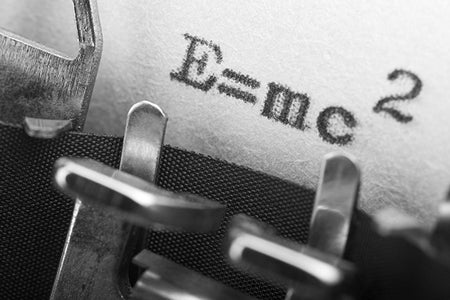
Was Einstein the First to Invent E = mc2?
The great physicist was not the first to equate forms of mass to energy, nor did he definitively prove the relationship
Tony Rothman is a physicist and writer. He received a B.A.in physics from Swarthmore College in 1975 and a Ph.D. from the Center for Relativity at the University of Texas, Austin in 1981. His area of specialization is cosmology, the study of the early universe, and he has authored about sixty scientific papers on that subject. While a graduate student Rothman studied Russian at Middlebury's Summer Language School and at Leningrad State University. After leaving Texas he did post-doctoral work in cosmology at Oxford, Moscow and Cape Town. Rothman has been on the Editorial Board of Scientific American (1988-1989). From 1990 to 1992 he was a Lecturer at Harvard. He has also been on the faculty at Bennington, Illinois Wesleyan University, Bryn Mawr College and since 2006 has been a lectuter at Princeton University. He is a board member of the Lifeboat Foundation. Apart from his scientific work, Rothman is the author of nine books. Most recent is Sacred Mathematic: Japanese Temple Geometry, with Fukagawa Hidetoshi (Princeton University Press, 2008), which won the 2008 American Association of Publishers Award for Professional and Scholarly Excellence in mathematics. Previous books are Everything's Relative and Other Fables From Science and Technology (Wiley, 2003); Doubt and Certainty with George Sudarshan (Perseus, 1998); a novel The World is Round (Ballantine/del Rey 1978), three collections of essays: Frontiers of Modern Physics (Dover, 1985), Science a la Mode (Princeton, 1989; paperback, 1991), A Physicist on Madison Avenue, (Princeton, 1991); a collection of short stories about Russia entitled Censored Tales (Macmillan London, 1989); and Instant Physics (Ballantine, 1995). Doubt and Certainty was chosen by the "A-List" as one of the 200 most notable books of 1998. Both Princeton books were chosen as Library of Science Book Club selections; A Physicist on Madison Avenue was nominated for the Pulitzer Prize. Rothman was the scientific editor for Sakharov's memoirs (Knopf, 1990). In addition Rothman has written five plays, The Magician and the Fool, which won the Oxford 1981-1982 Experimental Theatre Club Competition; The Sand Reckoner, staged at Harvard in 1995; Melisande (1991); Plausibility, about Hedy Lamarr and George Antheil (1998); and recently, The Fiery Angel. His work on Galois won the Mathematical Association of America's Ford Writing Award for 1983. Rothman has contributed to The New Republic, Boston Review, Bostonia, Scientific American, Discover, Analog, Astronomy, the Gettysburg Review, American Scholar, American Scientist and elsewhere, and has appeared frequently on public radio.
Was Einstein the First to Invent E = mc2?
The great physicist was not the first to equate forms of mass to energy, nor did he definitively prove the relationship

Apocalypsis du Jour, Amnesia Forever!
Look East, Young Man
Japanese Temple Geometry
During Japan's period of national seclusion (1639--1854), native mathematics thrived, as evidenced in sangaku- wooden tablets engraved with geometry problems hung under the roofs of shrines and temples
Pride and Prejudice
Cosmic lithium suggests the universe is open
Moscow Subversive Chic
Dissent glues together the traditional chaos
Ambidextrous Universe
New particles blur distinction between fermions and bosons
In Memoriam
The 300-foot radio telescope has collapsed
Time after Time
Once more the black-hole time machine
The Cygnet Turns Phoenix
Hercules X-l joins Cygnus X-3 as emitter of cosmic mysteries
Plus Ça Change...
Once again: The gravitational constant is constant
God Takes a Nap
A computer finds that Pluto's orbit is chaotic
Phase Transition
Electrorheological fluids flourish in drought
Son of Rubber
Rubber doped with iodine becomes an electrical conductor
The Short Life of Évariste Galois
Legend has it that the young mathematician wrote down group theory the night before he was fatally shot in a duel. More careful investigation shows that Galois's remarkable ideas took somewhat longer to mature