
This article was published in Scientific American’s former blog network and reflects the views of the author, not necessarily those of Scientific American
When a submarine, an unarmed German civilian merchant cargo-carrying submarine, quietly steamed into Baltimore harbor, its arrival won a victory in the political and economic battle that was part of World War I.
During the war, trade with neutral nations, such as the United States, was completely legal for all belligerants. In practise, the British Royal Navy had imposed a blockade that prevented all trade, including food and medicine, from benefiting Germany and Austria-Hungary. The “Deutschland” carried a cargo of chemical dyes used by industry along with medical drugs, among other non-military goods, and sailed on behalf of a German business consortium. The accompanying article in Scientific American, today 100 years ago, said:
“A company was formed in Bremen and several large cargo-carrying U-boats were laid down. The first of these, the ‘Deutschland,’ left Bremen with a cargo of dyestuffs and chemicals on June 14th [1916], and shaped her course for Heligoland. There, she remained for nine days, for the purpose, so her captain stated, of throwing the enemy off the scent, if, by any means, he should have learned of what was being attempted. ‘Deutschland’ was manned by a crew of eight officers and twenty-one men. She was under the command of Captain Koenig.”
On supporting science journalism
If you're enjoying this article, consider supporting our award-winning journalism by subscribing. By purchasing a subscription you are helping to ensure the future of impactful stories about the discoveries and ideas shaping our world today.

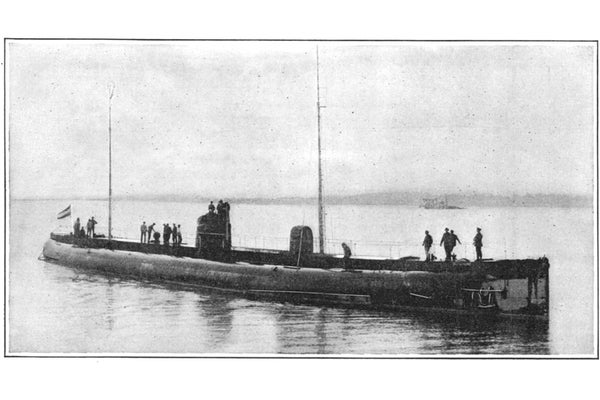
The submarine “Deutschland” and a harbor tug, showing the radio masts up and giving a good indication of the unusual bulkiness of the merchant submarine. Credit: Scientific American, July 22, 1916
The cargo was less important than the fact that the arrival of the submarine had outwitted the British intent to strangle their enemies economically. The Allies protested that an unarmed submarine could not really qualify as a merchant vessel and had to be treated like a ship of war. The United States, sensitive to the fact that the Royal Navy was preventing all trade with the central powers, held to the position that an unarmed vessel was a merchant vessel. The return cargo consisted largely of raw materials such as nickel and rubber—not weapons, but material that was very useful for military goods. The amount of cargo was tiny, compared with the actual political value of the propaganda victory of having successfully outwitted, if only temporarily, the intent of the Allied blockade while simultaneously reminding the United States that Germany had long historical ties and could be a friend and trading partner.
The submarine made only one more journey as a merchant trader. As relations between Germany and the United States deteriorated, the boat was requisitioned by the German Navy and armed with torpedo tubes and deck guns.

Sea Dog: Captain Paul Koenig of the cargo submarine “Deutschland.” He became a minor celebrity in the United States and was therefore highly useful for propaganda purposes. Credit: Scientific American, July 22, 1916