
This article was published in Scientific American’s former blog network and reflects the views of the author, not necessarily those of Scientific American
In the process of technology and mass production, the first step is basic research. This article from Scientific American of April 8, 1916, looks at one of the scientific tools of the trade: the Naval Experimental Wind Tunnel at the Washington Navy Yard.
Driven by a 500-horsepower motor, wind speeds inside the tunnel reached 75 miles per hour, “which permits experiments being made at real flying speeds.” The airflow needed to be consistent and the measurements accurate. The projects were varied:
“Among recent investigations of interest made at the wind tunnel was the determination of the coefficient of air friction for various aeroplane and balloon fabrics. Tests have been made on the new dirigible building for the Navy Department, and on models of naval airplanes both building and projected.”
On supporting science journalism
If you're enjoying this article, consider supporting our award-winning journalism by subscribing. By purchasing a subscription you are helping to ensure the future of impactful stories about the discoveries and ideas shaping our world today.
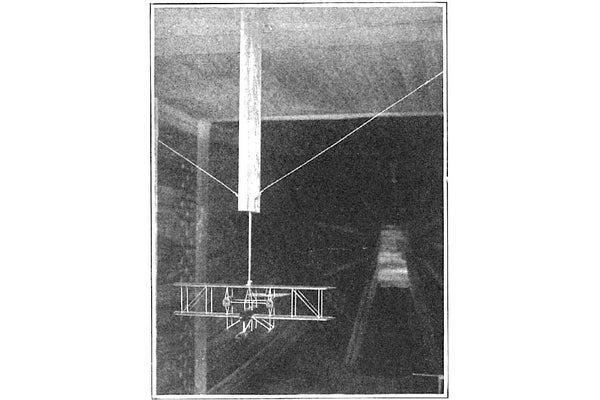
“On account of the large size of the tunnel it is possible to test comparatively large models of aeroplanes with widths up to 36 inches.”

Diagram of the Naval Experimental Wind Tunnel at the Washington Navy Yard.
Image: Scientific American Supplement, April 8, 1916
“The accompanying photograph shows the arrangement of the model of an aeroplane when being tested, carried by a steel spindle which extends up throught the top fo the tunnel to the weighing balance placed above.”
“When a model is set at a given angle the moments acting about each of three axes are measured by weighing them on a scale.”
“The tunnel makes it possible to test full-size radiators for aeroplane motors, and comparative tests have recently been made on several types both as to air resistance and cooling capacity.”
It would be interesting to compare the research being done at the time in the warring European nations, but I suspect they would have been less likely to allow a science journal to send a nosy reporter to one of their sensitive military installations.
-
Our full archive of the war, called Scientific American Chronicles: World War I, has many articles from 1914–1918 on technology and science in the First World War. It is available for purchase at www.scientificamerican.com/products/world-war-i/