
This article was published in Scientific American’s former blog network and reflects the views of the author, not necessarily those of Scientific American
A good rifleman or hunter will check the windage and adjust his or her rifle sights before loosing a shot. In World War One, weather reports and prevailing wind was generally noted on behalf of the artillery, an important consideration when guns were fired at enemies so distant that it was difficult or impossible to know where the shell landed.
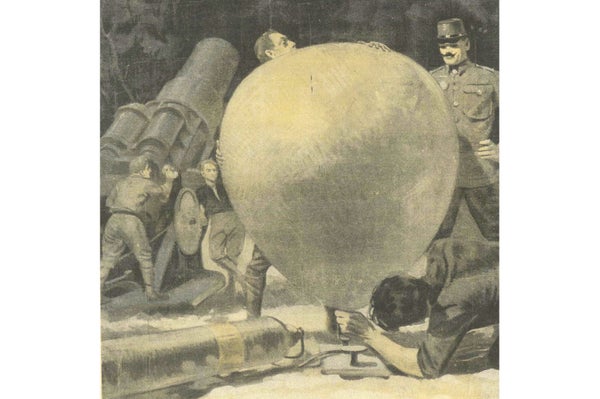
The image on the front of the September 23, 1916, issue, of 100 years ago today shows an officer in the (I believe, as there is no further information) Austrian-Hungarian army directing the deployment of a hydrogen-filled balloon to be sent up to check the wind speed and direction prior to firing the large howitzer (probably a 305 millimeter or 420 millimeter caliber Skoda gun) shown in the background.

Chemistry of war: troops filling observation or sounding balloons with hydrogen gas. Credit: Scientific American Supplement, September 30, 1916
On supporting science journalism
If you're enjoying this article, consider supporting our award-winning journalism by subscribing. By purchasing a subscription you are helping to ensure the future of impactful stories about the discoveries and ideas shaping our world today.
The balloon is being filled from a cylinder most likely with hydrogen: helium was much scarcer and less efficient in lifting power. Our photograph from a week later shows a bank of cylinders used by French troops for filling observation balloons.
-
Our full archive of the war, called Scientific American Chronicles: World War I, has many articles from 1914–1918 on the technology of warfare on the Western Front in the First World War. It is available for purchase at www.scientificamerican.com/products/world-war-i/