
This article was published in Scientific American’s former blog network and reflects the views of the author, not necessarily those of Scientific American
Reported in Scientific American, This Week in World War I: January 29, 1916.
Horses were a vital necessity for all armies in World War 1. Their use as cavalry or mounted infantry was limited, mostly to the Middle East and occasionally on the Eastern Front in Russia. But the greatest value of the horse, even in the age of mechanized trucking, was for transport on rough, uneven ground, hauling guns, supplies, ambulances and occasionally messengers. Millions served alongside troops. The United States alone provided almost 1,000,000 horses for the Allied war effort and more than 180,000 went to war with the U.S. forces.
Horses that were injured or sick could be returned to service if they were cared for. In every army, veterinary services were in high demand. This article on German military veterinarians was written by Alfred Gradenwitz, a freelance journalist living in Berlin and providing most of the articles to publications in still-neutral America, including Scientific American. Germany and Austria were suffering from a tight naval blockade and so had few options for importing new horses, which gave their veterinary hospitals a more important role:
On supporting science journalism
If you're enjoying this article, consider supporting our award-winning journalism by subscribing. By purchasing a subscription you are helping to ensure the future of impactful stories about the discoveries and ideas shaping our world today.

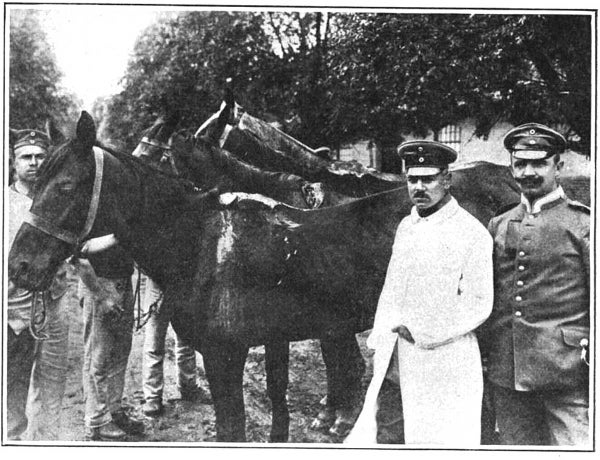
Salvarsan treatment for a horse. The drug was introduced in 1910 as a treatment for syphilis, but veterinarians found it useful for treating contagious pneumonia in horses.
Image: Scientific American, January 29, 1916
“In spite of the growing importance of motor cars and the prominent part incumbent on railways, ours is by no means a horseless age. In fact, the present war, while evidencing the wonderful mechanical progress of our era, throws the horse into unexpected prominence. When it is considered that each army corps, on a war footing, comprises tens of thousands of horses, it will be readily understood that the total number of those used by all belligerents should amount to some millions. The veterinary service for these quadruped armies therefore raises a number of problems and assumes an unprecedented importance, second only to sanitation in wartime.”
“The treatment of wounded and sick horses, then, takes place at special veterinary hospitals which have, for the first time, been installed during the present war. The writer is indebted to Veterinary Surgeon-Major Ohm and Major von Papen, the medical and military directors respectively of the Insterburg Veterinary Hospital, for the pictures accompanying this article and for much of the information it is based upon.”
Retrospective casualty figures for horses during the war give figures as high as 8 million horses killed and died of disease. Many horses were killed after the war was over because health authorities feared the diseases they might bring home from the festering battlefields.
-
Our full archive of the war, called Scientific American Chronicles: World War I, has many articles from 1914–1918 on the various medical and veterinarian aspects of the First World War. It is available for purchase at www.scientificamerican.com/products/world-war-i/