
This article was published in Scientific American’s former blog network and reflects the views of the author, not necessarily those of Scientific American
Aviation technology in the First World War progressed by small leaps. Almost as soon as the war began the airplane started to prove its usefulness for reconnaissance on land. It was evident that the airplane would provide the same usefulness at sea:
Even the layman knows to-day that aircraft have materially altered the problems of military strategy. He knows that they have done this by reason of their ability to speed about aloft and to watch with measurable safety the movements of a foe and the distribution and kinds of forces at his command. In short, the aeroplane has permitted spying from high in the air. Just what has thus been done for armies in the field will, in the near future, be done for battle fleets or squadrons. The naval air pilot will become an invaluable aid to an admiral in planning how best to meet his foe or how, if that be the wiser conrse, to avoid an engagement with the enemy's fighting ships.
But there were problems with naval aviation. The range of a typical airplane was several hundred miles. Ships steamed for several thousand miles during a tour of duty. Ships beyond the range of land-based aircraft could bring their own seaplanes with them, stacked on top of the deck. But launching them was a problem. They had to be lowered over the side and launched from the open water:
On supporting science journalism
If you're enjoying this article, consider supporting our award-winning journalism by subscribing. By purchasing a subscription you are helping to ensure the future of impactful stories about the discoveries and ideas shaping our world today.
The stumbling block has been very largely the seaplane's inability to get a start from rough waters. The sturdiest of them are able to land upon something of a troubled sea, but their pontoons do not permit them to gain sufficient speed under those circumstances to insure the take-off for a flight. Therefore, even though they might be put overboard safely in the lee of a ship it has not been possible, except under the most favorable conditions of the water, to get them away in flight.
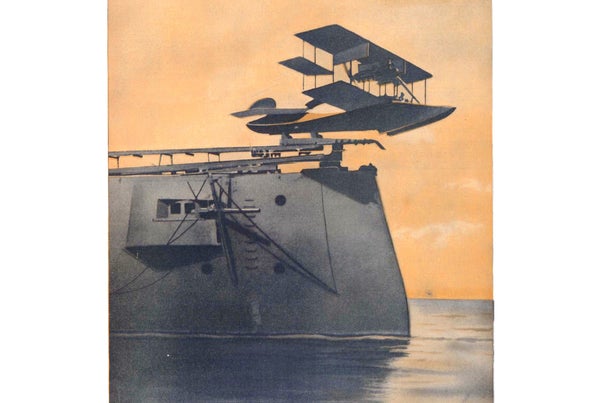
Decks could be built over with platforms, and experiments in 1910 and 1912 proved that airplanes could launch and land on these platforms. Over the years platforms expanded to become entire aircraft carriers. But platforms hampered the usefulness of the ship’s main guns. Enter the catapult. Experiments over several years culminated in the work of Captain Washington I. Chambers of the U.S. Navy to mount a catapult on the deck of an armored cruiser, which enabled the ship to launch an airplane while underway, at sea, thus providing the crucial step to launching naval aviation.

Testing aviation technology: the launching rail installed on the after deck of the U.S. armored cruiser “North Carolina” in 1916.
Image: Scientific American, March 18, 1916
-
Our full archive of the war, called Scientific American Chronicles: World War I, has many articles from 1914–1918 on the technology of the First World War. It is available for purchase at www.scientificamerican.com/products/world-war-i/