
This article was published in Scientific American’s former blog network and reflects the views of the author, not necessarily those of Scientific American
Reported in Scientific American, this Week in World War I: January 8, 1916.
At the outbreak of World War I the airplane was only 11 years old. Its first and most useful military task was as “eyes in the sky,” unmasking enemy troop movements. Naval commanders wanted the same capability as soon as possible.
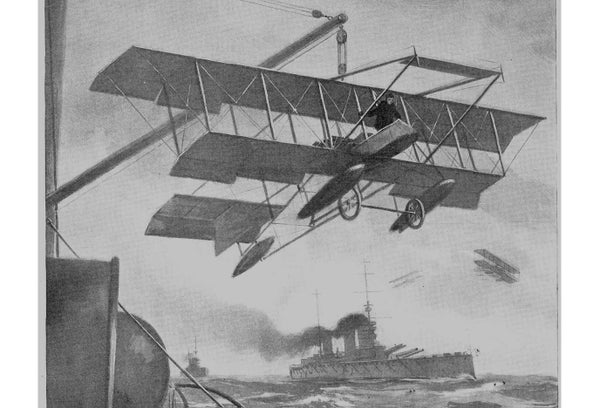
Technical problems limited the role of aircraft for naval use, however. Aircraft range was far more limited than ship range, and until 1916, before the advent of aircraft carriers and catapult launchers, airplanes could not be launched from the decks of ships. The interim solution is shown on the cover of the issue from January 8, 1916: floatplanes were carried by ships, lowered by crane onto the surface of the ocean for takeoff, and picked up in the same way after they landed. A description of the shortcomings of the procedure comes from the issue of March 18, 1916:
On supporting science journalism
If you're enjoying this article, consider supporting our award-winning journalism by subscribing. By purchasing a subscription you are helping to ensure the future of impactful stories about the discoveries and ideas shaping our world today.
“The stumbling block has been very largely the seaplane's inability to get a start from rough waters. The sturdiest of them are able to land upon something of a troubled sea, but their pontoons do not permit them to gain sufficient speed under those circumstances to insure the take-off for a flight. Therefore, even though they might be put overboard safely in the lee of a ship it has not been possible, except under the most favorable conditions of the water, to get them away in flight.”
The aircraft shown in this image seems to be a Farman hydroaeroplane, a French design using a propeller in a “pusher” configuration. The mixture of wheels with floats does seem odd, but it is possible that the artist was working with the best available information but did not have direct access to the subject.
-
Our full archive of the war, called Scientific American Chronicles: World War I, has many articles from 1914–1918 on aviation and other technology of the First World War. It is available for purchase at www.scientificamerican.com/products/world-war-i/