
This article was published in Scientific American’s former blog network and reflects the views of the author, not necessarily those of Scientific American
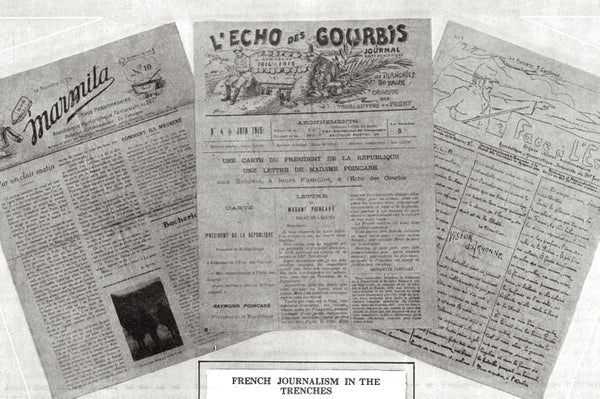
The business of war is grim, but humanity, humor, intellect, thought—perhaps even truth—do not perish in the worst of circumstances. As evidence, I can show this article from 100 years ago today from Scientific American of June 24, 1916, titled “Newspapers That Are Printed Within Gun Range of the Enemy.” The article can speak for itself:
“In the trenches in Belgium and France, which wind as a serpent from the North Sea to the Vosges mountains, the serious business of warfare has not succeeded in smothering the old-time French gaiety in the soldiers of France. Substantial evidence of this is found in the many humorous newspapers that are being published in the trenches, within sound and range of enemy fire.”

“Print shop” of the trench newspaper Face a l’est (the right-hand one of the three shown above). Credit: Scientific American, June 24, 1916
On supporting science journalism
If you're enjoying this article, consider supporting our award-winning journalism by subscribing. By purchasing a subscription you are helping to ensure the future of impactful stories about the discoveries and ideas shaping our world today.
“A story is told of how Sargeant Bonneton, wishing to amuse his comrades of the 145th Territorial Regiment, resolved to publish a trench newspaper which would contain news, anecdotes, and even sketches representing the efforts of local talent. The captain of the company approved of the idea, and even went to the extent of furnishing the necessary paper and the copying ink. But the copying paste was still lacking, so the would-be publishers set about to find the all-important requisite. Ruined villages in back of the lines were searched, and after diligent pursuit of their task the searchers were rewarded by a find of gum, as well as several cake tins for holding it.... Yet just as the impressions were being made and them men were about to realize their ambitions, a German 77 mm. shell fell in the midst of the improvised print shop, putting the quietus on the publishing activities. Undaunted, however, the men recommenced their work; and in a short time the first number of the Fanion made its appearance in the form of over 100 copies.” [The title is listed but not reproduced for viewing at the Bibliothèque Nationale de France (see URL below); its editors are given as Charles Ygouff and Guy Bonneton]”
Publications by soldiers on active duty in the midst of war have a much longer history than the First World War. Such publications have always had an uneasy existence, threading between the needs of military censorship and the desire for soldiers to communicate and be informed or entertained. A fine and succinct article on the subject by Robert L. Nelson of the University of Waterloo is freely available at http://encyclopedia.1914-1918-online.net/article/soldier_newspapers
Some examples of Canadian trench newspapers are at: http://www.canadiana.ca/en/ECO/trench-journals
A variety of examples of trench newspapers of several nations—including France, Germany and the United States—as well as propaganda publications aimed at the enemy and newspapers published in POW camps, is available courtesy of Moreno Vally College in California: http://researchguides.mvc.edu/c.php?g=38227&p=243707
Examples en Francais: Bibliothèque Nationale de France
http://gallica.bnf.fr/html/und/histoire/journaux-de-linfanterie
And a sister company to Scientific American, Palgrave Macmillan, published a book in 2013 by Graham Seal: The Soldiers’ Press: Trench Journals in the First World War, but I haven’t seen a copy of it yet.
-
Our full archive of the war, called Scientific American Chronicles: World War I, has many articles from 1914–1918 on trench warfare in the First World War. It is available for purchase at www.scientificamerican.com/products/world-war-i/