
This article was published in Scientific American’s former blog network and reflects the views of the author, not necessarily those of Scientific American
In the second year of the Great War production capacity was strained to the limit to produce enough food war materièl to supply the vast armies locked in the struggle for survival on the continent of Europe. In the Scientific American Supplement 100 years ago today, an article borrowed from the Railway Age Gazette spoke of this enormous task:
“Feeding the Firing Line”
By Walter S. Hiatt
As much science is employed in putting food into a soldier's mouth as in putting bullets into his opponent's skin. There is more method in supplying food to cavalry and wagon horses, gasoline to army automobiles, shells to cannon, medical supplies to hospitals or material to tbe engineering corps, than there is madness in the war itself.
The task of carrying supplies to an army of 4,000,000 men, concentrated, as in France, on a line 600 miles long by 20 deep is one of the most complicated of the war. It does not hegin to give a conception of the vast transportation problems involved to say that daily 25,000 tons of rations must be forwarded to the soldiers, that 1,000,000 quarts—a veritable river— of wine must reach them, that 75 tons of lead must be shipped for each German killed or wounded, or that the cost of the war material forwarded each day is $10,000,000 [$220,000,000 in 2016 dollars]. One railroad alone furnishes more than 3,500 cars a day for army transportation purposes; 100,000 automobiles and 600,000 wagons are required to distribute the shipments at the front.”
On supporting science journalism
If you're enjoying this article, consider supporting our award-winning journalism by subscribing. By purchasing a subscription you are helping to ensure the future of impactful stories about the discoveries and ideas shaping our world today.
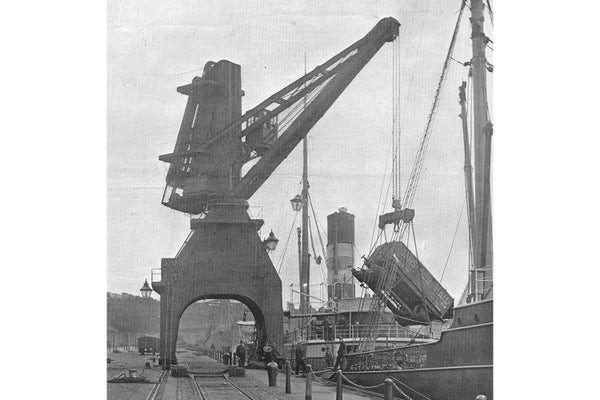
Coal, its extraction and shipment, was integral to the ability of railways to move, and factories to produce ammunition. On the cover of the same issue, a photograph shows a method of moving coal more efficiently on the docks in England: an entire railway car full of the stuff is carried aloft and the contents dumped into the cargo hold of a waiting ship for export, probably to France.