
This article was published in Scientific American’s former blog network and reflects the views of the author, not necessarily those of Scientific American
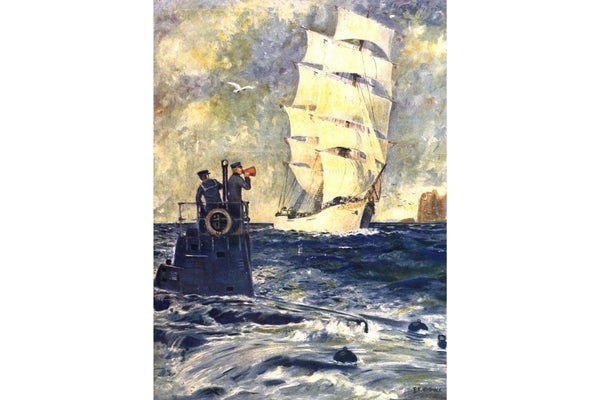
The cover of the April 1, 1916, issue of Scientific American carries an image of one of the most controversial aspects of the war. There is no caption, and I cannot identify the nationality of either the submarine or the sailing ship. But it seems clear that a submarine has surfaced and is hailing a civilian sailing ship carrying cargo.
“Cruiser rules” were in effect (by international agreement) in early 1916 for war at sea. Military vessels could stop merchant or passenger ships at sea and search them. If the ship was found to belong to the enemy or if it was found to be carrying military supplies for enemy forces, the crew and any passengers were to be taken off the ship, to a place of safety, and the ship could be captured or sunk.
In reality, if submarines surfaced to follow these rules they lost their greatest advantage—stealth—and they became highly vulnerable to attack. As the war progressed, new naval tactics and weapons increased the risk to submarines. Also, as entire economies were shifted to assist in the war effort, any supplies, including food for civilians, could be considered to be aiding an enemy’s war effort.
On supporting science journalism
If you're enjoying this article, consider supporting our award-winning journalism by subscribing. By purchasing a subscription you are helping to ensure the future of impactful stories about the discoveries and ideas shaping our world today.
The British Royal Navy had been enforcing a strict blockade of surface ships since the war began, causing severe shortages of food and critical supplies in Germany and Austria-Hungary. The German Kriegsmarine, unable to directly challenge the stronger British fleet, tried to create a blockade of its own with its submarines.
Eventually the Germans abandoned the risky “cruiser rules.” They turned instead to a policy of “unrestricted submarine warfare” ten months after this image was published, where any ship was at risk of being torpedoed without warning. The new policy was one of the reasons the United States declared war on Germany on April 6, 1917.
-
Our full archive of the war, called Scientific American Chronicles: World War I, has many articles from 1914–1918 on submarine warfare and the politics of this weapon in the First World War. It is available for purchase at www.scientificamerican.com/products/world-war-i/