
This article was published in Scientific American’s former blog network and reflects the views of the author, not necessarily those of Scientific American
Reported in Scientific American, This Week in World War I: February 12, 1916.
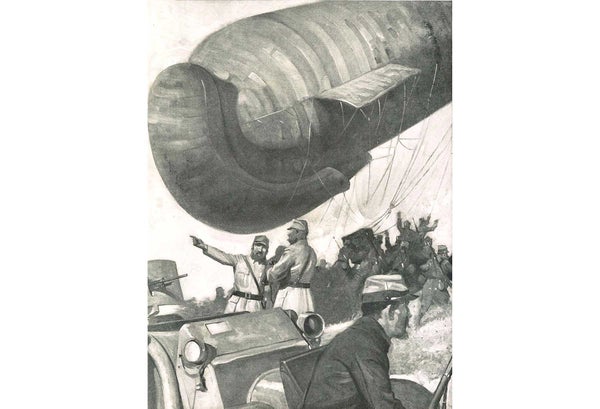
The cover of the February 12, 1916, issue of Scientific American has an image of a military balloon: “Hauling a French observation balloon to a new signalling post.”
The balloon in question is a Parseval-Sigsfeld kite balloon, first introduced in Germany in 1896, but used by all armies involved in the First World War. Ordinary balloons could be buffetted about by wind; this design had features that helped keep it stable and pointing into the wind, such as a more elongated shape, the stubby wings and its distinctive sausage-like tail. It is considered a “kite balloon” because it was held at a slant that helped loft it more quickly, like a kite, to an altitude where observers could report on enemy troop movements and provide target information for artillery. The balloons were useful, large, filled with flammable hydrogen, frequently targeted by enemy airmen, and therefore were hauled down and moved often by motorized vehicle.
On supporting science journalism
If you're enjoying this article, consider supporting our award-winning journalism by subscribing. By purchasing a subscription you are helping to ensure the future of impactful stories about the discoveries and ideas shaping our world today.

Tests in 1897 of the observation balloon designed by Captain Perseval of the German army.
Image: Scientific American, July 3, 1897
This comment on observation balloons comes from the August 28, 1915, issue:
“These combination balloon and automobile observatories have proven so successful that a great number are under construction at the present moment. The perfection of these air sentinels is only another phase of the rapid strides being made in the science of war.”
-
Our full archive of the war, called Scientific American Chronicles: World War I, has many articles from 1914–1918 on the Western Front of the First World War. It is available for purchase at www.scientificamerican.com/products/world-war-i/