
This article was published in Scientific American’s former blog network and reflects the views of the author, not necessarily those of Scientific American
Yesterday I suffered a mysterious blog FAIL around 1 or 2 pm eastern time. Half of my post about desmids -- intricate, microscopic plants -- vanished within an hour or so of publication. I didn't realize it until around 6 pm, when I fixed it. So if you read my post yesterday but there weren't any videos, go back and check it out again! There are quite a few treasures waiting for you.
Fellow Sci Am blogger Psi Wavefunction, who writes the lovely protist blog The Ocelloid, got in touch with me yesterday to let me know I should have checked with her for desmid photos. She graciously offered me these beautiful hi-res images and a few insights to go with them.
In this one, you can see the cell's nucleus -- the cell's DNA depot -- in between the two halves.
On supporting science journalism
If you're enjoying this article, consider supporting our award-winning journalism by subscribing. By purchasing a subscription you are helping to ensure the future of impactful stories about the discoveries and ideas shaping our world today.
Netrium sp.

Psi also notes that the tiny clear space around the nucleus is also where most of the cell's organelles are -- the rest of the cell is filled with nothing but the chloroplast and storage bags called vacuoles.
Here's a second desmid showing off both its nucleus and a series of organelles called pyrenoids that look like beads on a string.
Closterium sp.

Though it sounds like something that requires a soothing ointment, a pyrenoid is actually a site where CO2 is "fixed", or grabbed from the environment and incorporated into an organic compound during photosynthesis. This is why plants and algae act as CO2 scrubbers for Earth's atmosphere. Eventually, the fixed carbon dioxide will become part of the sugar glucose and ultimately long chains (polymers) of glucose called starch. The pyrenoid may even be sheathed in starch deposits, which seems to imply they are also involved in food storage.
The pyrenoid isn't a membrane-bound organelle like most are, but instead a dense aggregation of the photosynthetic enzyme RuBisCO -- perhaps the most abundant enzyme on earth. RuBisCO (I feel like RuBisCO needs to start its own line of snack crackers) performs the reaction where the rubber meets the road: attaching free-range carbon dioxide to ribulose 1,5-bisphosphate, a chemical intermediate on the way to glucose.
Although pyrenoids are common in algae and in a few early-evolved plants like hornworts (a moss relative), most land plants lack them, and the RuBisCO just floats free in their chloropasts. Perhaps having pyrenoids has something to do with life in water? Feel free to chime in in the comments if you know more about the mysterious pyrenoid.
One final note. Remember the "Do Not Touch" desmid, Staurastrum? Well, Psi pointed out a drawing by Wim von Egmond illustrating that desmids like Staurastrum have very interesting 3D shapes that are not well captured by 2D microscope images.Take a look! And to give you a sense for just how small these plants can be, here is a photograph by von Egmond of a Staurastrum being engulfed by an amoeba. Wow.

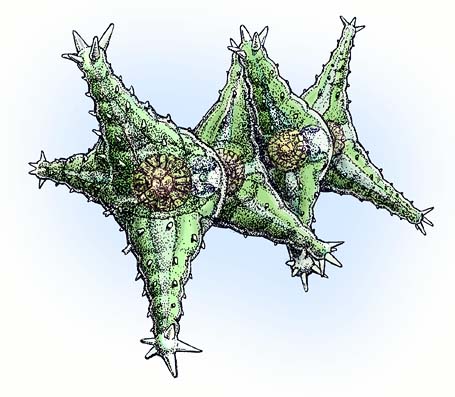
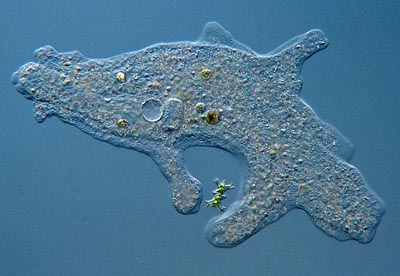
Thanks, Psi, for the beautiful desmid images and explanations!