
This article was published in Scientific American’s former blog network and reflects the views of the author, not necessarily those of Scientific American
Magazine issue closes are always hectic. We spend months working on each edition, but then for one week, roughly six weeks before publication, we have to triple-check each of the some 100 pages in the book and get them out the door in time to meet our monthly printer deadline. This close is different.
As I write this letter, it's 10 P.M. on Sunday, March 15. Last Tuesday our parent company, Springer Nature, told everyone in the New York City office that they could work from home because of the spread of coronavirus, and nearly everyone has availed themselves of the opportunity. On Wednesday the World Health Organization announced that the outbreak was a global pandemic. On Friday—the day we started sending pages for this issue to the printer—President Donald Trump declared a state of emergency in the U.S. And today New York Mayor Bill de Blasio said that public schools would close citywide.
So we're putting this issue to bed remotely—for many of us, with our kids running around wildly in the background. At the same time, we must keep up the daily news operation online, where you can find ongoing coverage of the coronavirus crisis, how it's impacting our lives and what's being done to stop it (visit sciam.com/coronavirusoutbreak for the latest). I'm not worried, because we have an amazing staff and because it's been done before. When Hurricane Sandy battered New York in 2012, our office building near the Holland Tunnel (we've since moved) was closed for a week.
On supporting science journalism
If you're enjoying this article, consider supporting our award-winning journalism by subscribing. By purchasing a subscription you are helping to ensure the future of impactful stories about the discoveries and ideas shaping our world today.
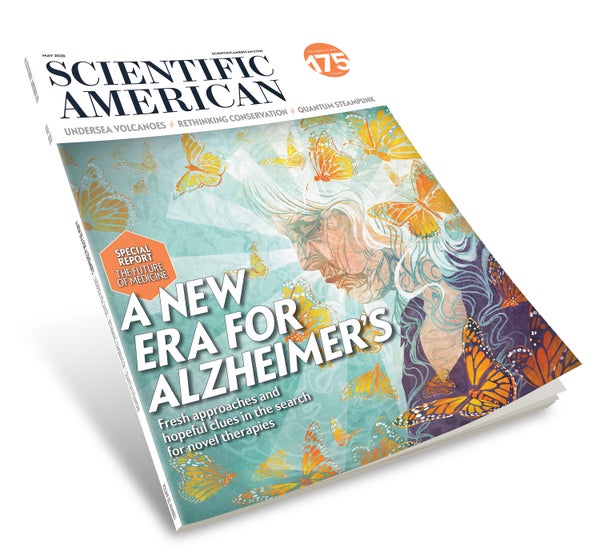
Also, while coronavirus is the scourge of the moment, it's important to not lose sight of the perennial maladies that afflict us. Between 40 million and 50 million people around the world currently live with Alzheimer's and related dementias, with more than two million deaths annually. And unlike COVID-19 (“coronavirus disease, 2019”), there's no “flattening the curve” here. Therapies for Alzheimer's, let alone a cure, have proved elusive in the more than 100 years since the ailment was first recognized. But as we reveal in this year's Future of Medicine report, “A New Era for Alzheimer's,” scientists are at long last reassessing the basic physiology and biology of the disorder to find new paths forward. Along the way, they are taking a close look at the “amyloid hypothesis” that has dominated research in the field for decades and paying more heed to underappreciated risk factors such as the ways that menopause may explain the higher prevalence of dementia in women and the role of air pollution in driving the disease forward.
Will this ostensible inflection point finally lead to effective treatments? It's too soon to tell, but with guarded optimism we carry on hoping for a breakthrough.
At least with coronavirus, we all have some agency over the blight. Governments are enacting civic restrictions, and people are undertaking “social distancing.” I hope these measures will help, but current predictions suggest the pandemic will continue for many months. Whatever the future may hold, stay safe and trust in science, not fear, to guide the way. And remember, subscribers have access to every issue online: visit sciam.com/digital-access for more information.