
This article was published in Scientific American’s former blog network and reflects the views of the author, not necessarily those of Scientific American
Having kicked off the week at the 48th annual World Economic Forum meeting at Davos by moderating a panel conversation around the challenges and opportunities for the “Global Science Outlook” in the coming year, I spent today in a series of fascinating discussions that highlighted the power of science to help in advancing discovery and addressing humanity’s grand challenges. A couple of them were recorded and live-streamed, so you will be able to see them, too.
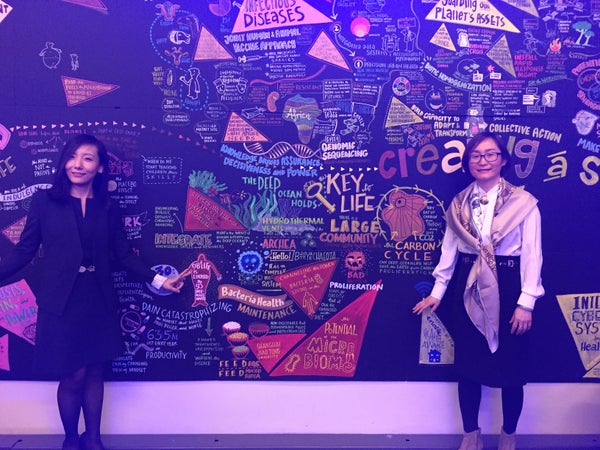
Zhang Chenhong and Wang Fengping, researchers at the Shanghai Jiao Tang University in China, presented their work on “The Potential of the Microbiome.” Wang talked about carbon-ingesting microbes located a remarkable 2.5 kilometers beneath the sea. Zhang discussed the microbiome in the body, and how it can be shaped by diet to address obesity.
How can the academic world build bridges to foster innovation? That was among the questions in “From Frontier Research to Innovation,” created with the European Research Council. Panelists talked about how science and business need to team up, and how frontier research is a critical base from which innovation can arise.
On supporting science journalism
If you're enjoying this article, consider supporting our award-winning journalism by subscribing. By purchasing a subscription you are helping to ensure the future of impactful stories about the discoveries and ideas shaping our world today.
Among the speakers at that session was Ben Feringa of the University of Groningen in the Netherlands, and a winner of the 2016 Nobel Prize in Chemistry. In the video below, from our live-streamed conversation, Feringa describes his journey from growing up on a farm, to synthesizing his first molecule at the age of 20 to working in industry to his Nobel-winning research on molecular machines. He also offers some tips on how to foster creativity, explains why it’s important in science to fail, and encourages us to take the long view on supporting basic research for its potential to change the world.
