
This article was published in Scientific American’s former blog network and reflects the views of the author, not necessarily those of Scientific American
Remember Irene? It was a hurricane that wreaked havoc along the eastern seaboard of the U.S. in 2011. As I reported on this blog, some environmental activists, notably Bill McKibben, blamed Irene on global warming, whereas others denounced that attribution as scientifically premature.
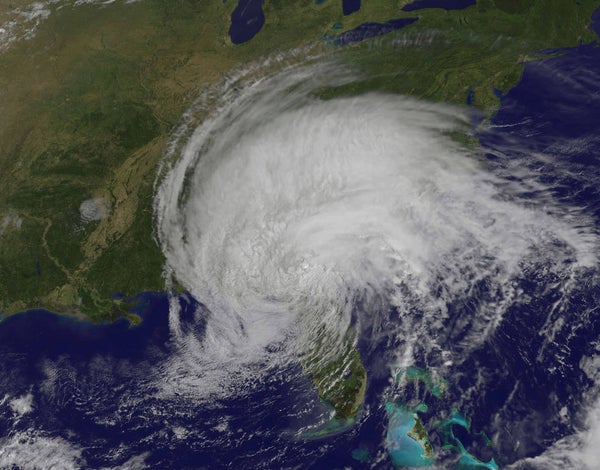
Here we go again. McKibben contends in The Guardian that global warming lurks behind hurricanes Harvey, Irma (pictured above) and Jose as well as a record-shattering heat wave in San Francisco, forest fires in the Pacific Northwest and a drought in North Dakota and Montana. He argues that “every one of these events jibes with what scientists and environmentalists have spent 30 fruitless years telling us to expect from global warming.” McKibben’s headline: “Stop talking right now about the threat of climate change. It’s here; it’s happening.”
Journalist Dave Roberts quibbles with the straightforward hurricane/warming claim in Vox. He notes that "it is grossly irresponsible to leave climate out of the story, for the simple reason that climate change is, as the US military puts it, a threat multiplier.” But he adds that “the jury is still out" as to whether “climate change increases hurricane frequency.”
On supporting science journalism
If you're enjoying this article, consider supporting our award-winning journalism by subscribing. By purchasing a subscription you are helping to ensure the future of impactful stories about the discoveries and ideas shaping our world today.
Journalist Chris Mooney, whose 2008 book Storm World explored the complex, contentious science tying global warming to extreme weather, is similarly cautious in The Washington Post. He says scientists “might be on the cusp” of demonstrating that a given hurricane, such as Harvey, “was statistically more likely to occur,” but they haven’t quite gotten there yet.
In a sensible column for Scientific American, climate scientist Michael Mann and two co-authors state that two consequences of global warming--rising sea levels and warming oceans--are definitely boosting flooding and hence destruction caused by storms. They acknowledge the uncertainty of attributing an individual storm to climate change.
But it would be “imprudent," they conclude, to "wait for the results of formal detection and attribution studies before we can say anything about the effects of climate change on hurricanes as they are happening. There is much that we know based on physics, and we should state those things clearly and immediately, as they can provide insights that can help guide people as they begin to recover and plan for the future.”
One intriguing twist, reported by The New York Times, is that Republican officials are bickering about the hurricane/climate change link. Scott Pruitt, head of the Environmental Protection Agency, said it is “insensitive” to talk about possible causes of Harvey and Irma.
“To have any kind of focus on the cause and effect of the storm versus helping people, or actually facing the effect of the storm, is misplaced,” Pruitt said. Like his boss Donald Trump, Pruitt has expressed skepticism about human-induced global warming.
Tomás Regalado, mayor of Miami and a Republican, vehemently disagreed with Pruitt. “This is the time to talk about climate change," he said. "This is the time that the president and the E.P.A. and whoever makes decisions needs to talk about climate change. If this isn’t climate change, I don’t know what is. This is a truly, truly poster child for what is to come.”
Careful scientific studies seem to have little impact on our Republican leadership. So here’s my question: How many more destructive storms, heat waves and droughts will it take for that leadership to acknowledge the threat of climate change and do something about it? And by that time, will it be too late? As McKibben notes, “Global warming is the first crisis that comes with a limit--solve it soon or don’t solve it. Winning slowly is just a different way of losing.”
Further Reading: