
This article was published in Scientific American’s former blog network and reflects the views of the author, not necessarily those of Scientific American
Next week, I’m attending a meeting of scholars, journalists, activists and others on polarization in politics and science. I’ve been asked to kick off a discussion of “what is settled and what is contested” in the climate-change debate. What are facts, in other words, and what are opinions?
This post previews what I plan, tentatively, to say at the meeting. My first point will be that nothing is settled. Every climate-change claim is contested by someone--blowhards running for President, for example. So the list below, which is skewed toward issues I’ve written about, represents my opinion of what are facts and opinions. Your opinions welcome.
CLIMATE-CHANGE FACTS
On supporting science journalism
If you're enjoying this article, consider supporting our award-winning journalism by subscribing. By purchasing a subscription you are helping to ensure the future of impactful stories about the discoveries and ideas shaping our world today.
FACT: Carbon dioxide, a byproduct of fossil-fuel combustion, is a greenhouse gas, which traps solar radiation in the atmosphere. (Sources for my first seven “facts” include NASA and the Intergovernmental Panel on Climate Change.)
FACT: Increased human fossil-fuel consumption over the past two centuries has increased levels of carbon dioxide in the atmosphere. Atmospheric CO2 recently surpassed 400 parts per million, the highest level in more than 800,000 years.
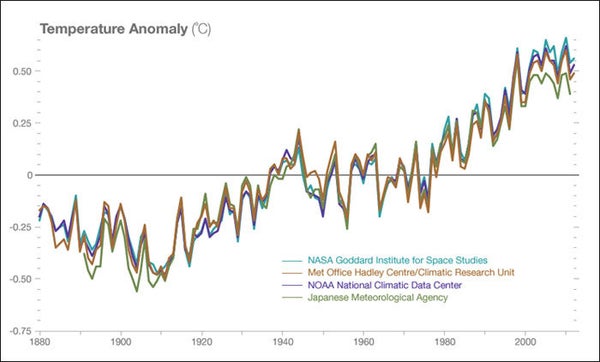
FACT: As a result of increases in atmospheric carbon dioxide, global surface temperatures have increased by about one degree centigrade since 1880. The 10 warmest years ever recorded—with the exception of 1998—have occurred since 2000. 2014 was the warmest year ever recorded.
FACT: Arctic ice and glaciers around the world have shrunk markedly in recent decades, although in 2014 “ice surrounding Antarctica reached a new record high,” according to NASA.
FACT: Sea levels have risen 6.7 inches over the past century as a result of human-induced global warming. This sea-level rise, which is accelerating, makes coastal storms more destructive.
FACT: Reasonable extrapolations from current trends suggest that unchecked fossil-fuel consumption will increase the risk of coastal flooding, droughts, severe storms, heat waves, food and water shortages and other harmful effects.
FACT: A consensus of scientific experts believes that fossil-fuel consumption is driving global warming.
FACT: Scientific experts can be wrong.
FACT: Some influential criticism of the scientific consensus on climate change has been motivated by pro-capitalist, anti-socialist ideology.
FACT: Not all those who doubt the scientific consensus on climate change are ideologues or idiots.
FACT: Some left-wing activists have used climate change to promote a socialist agenda.
FACT: Fossil-fuel consumption was key to the industrial revolution, which over the past two centuries has boosted average global incomes six-fold and decreased the proportion of people living in extreme poverty.
FACT: The United States, historically, has been the biggest emitter of carbon dioxide and hence bears the greatest responsibility for climate change.
FACT: Those who agree that climate change poses a threat vehemently disagree about how severe the threat is, how it should be countered and how it should be discussed in public.
CLIMATE-CHANGE OPINIONS:
OPINION: If humanity does not take dramatic steps to curtail fossil-fuel consumption, civilization may collapse.
OPINION: Climate change could make armed conflict, including wars over water, more likely.
OPINION: Global warming is already causing “extreme” weather events, such as hurricanes Katrina and Sandy and the current drought in California.
OPINION: Nuclear energy is necessary for countering climate change.
OPINION: The natural-gas boom, made possible by advances in fracking, has on balance been good for the environment, because it has reduced reliance on coal, a far more damaging pollutant.
OPINION: Optimism is a more constructive approach than pessimism to countering the climate change and other threats to humanity.
Addendum: More facts/opinions:
FACT: Coal pollution leads to hundreds of thousands of premature deaths each year.
OPINION: Al Gore's efforts to counter global warming have hurt that cause by associating it in the minds of many Americans with a liberal political perspective. (Some of my colleagues at Stevens Institute of Technology have voiced this opinion.)
Correction: The 10 warmest years ever recorded—with the exception of 1998—have occurred since 2000, not within the last decade (as previous draft stated).