
This article was published in Scientific American’s former blog network and reflects the views of the author, not necessarily those of Scientific American
Certain scientific breakthroughs always seem to be a few years away. The first direct observation of a black hole has long fallen into this category. Maybe not for much longer: the astronomers of the Event Horizon Telescope have scheduled their first full-on attempt to image the black hole at the center of the Milky Way for next spring.
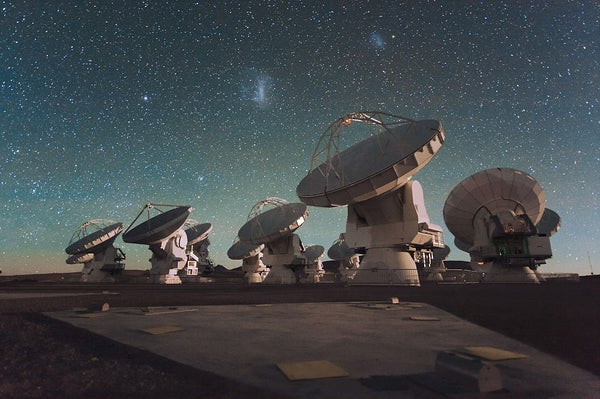
On two nights in April 2017, eight observatories around the world—including the Atacama Large Millimeter Array (ALMA) and the South Pole Telescope—will simultaneously observe Sagittarius A*, the supermassive black hole at the galactic center. (The EHT will also observe the much larger black hole at the center of the galaxy M87.) Together, these observatories will function as a single Earth-size telescope capable of directly imaging the black hole’s event horizon, the boundary through which anything that passes can never return.
The Event Horizon Telescope is an international collaboration involving high-frequency radio observatories in Europe, North America, South America, and Antarctica. (More background on the project here.) Using a technique called very long baseline interferometry, scientists can mimic the effect of impractically huge telescopes, thereby reaching higher levels of resolution than any other astronomical instrument. The array will be sharp enough to see a DVD on the moon. That’s acute enough to detect the “shadow” Sagittarius A* is thought to cast on the bright emission coming from near the event horizon.
On supporting science journalism
If you're enjoying this article, consider supporting our award-winning journalism by subscribing. By purchasing a subscription you are helping to ensure the future of impactful stories about the discoveries and ideas shaping our world today.
It takes a long time to reduce the data from an experiment like this, so even if the observation goes perfectly, will probably be months before we see a picture. And there is, of course, no guarantee that the observation will go perfectly. But the fact that the experiment is scheduled is a big deal. It hasn’t been easy for these astronomers to get this point.
If you’ve followed the EHT, you might recall a flurry of media stories in January announcing that the first picture of a black hole was “due” in 2017. At the annual meeting of the American Astronomical Society, Feryal Ozel, a scientist with the project, said, with appropriate caution, that they were “hoping” for a full array observation in early 2017. That nuance disappeared in the online coverage. The fact is that the first full-array observation wasn’t a done deal until recently, when the EHT officially received observing time on ALMA, the 66-dish observatory high in the Chilean desert that will increase the sensitivity of the Event Horizon Telescope by a factor of ten.
There is still a lot of work to do in the coming months. For example, before next April, the Large Millimeter Telescope in Mexico needs a new receiver capable of recording the same 1.3-millimeter wavelength as the rest of the stations. In December, a team will travel to the South Pole Telescope to install a new high-frequency receiver there, too. There are tests to run, checklists to write, protocols to invent. I’ll be following this progress closely.