
This article was published in Scientific American’s former blog network and reflects the views of the author, not necessarily those of Scientific American
Does your dog know the names of her toys? How about the names of over 1,000 of her toys? No one is suggesting that 1,000 become the new normal (or that your dog have that many toys), but when a dog accomplishes this feat, it’s worth learning how she did it.
If you’ve read anything about dogs in the last 5 years, you’ve surely come across Chaser the Border Collie (Facebook). Under the guidance of her human, John Pilley, an emeritus professor of psychology at Wofford College, Chaser demonstrated proficiency in object naming and discrimination, highlighted in a 2011 publication in Behavioural Processes. A subsequent 2013 publication in Learning and Motivation identified her ability to discriminate verbs, such as fetch frisbee, paw frisbee, or nose frisbee, as well as attend to the syntax in sentences: “to ball take Frisbee” is different from “to Frisbee take ball.”
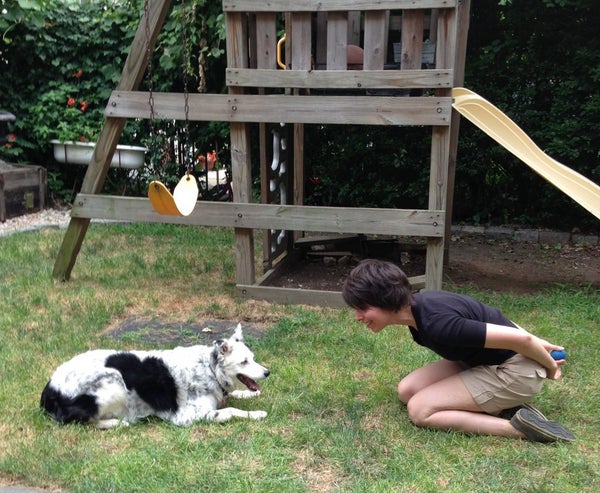
Chaser is a reminder that the journey is as worthwhile as the destination. Wonder how she did it? I’ve met Chaser (see top picture), and from the first meeting it was apparent that this was a two-way street: Chaser was interested and motivated, but so too was Pilley, fostering an environment that was a gateway to all this learning. Pilley described their journey in the book
On supporting science journalism
If you're enjoying this article, consider supporting our award-winning journalism by subscribing. By purchasing a subscription you are helping to ensure the future of impactful stories about the discoveries and ideas shaping our world today.
Chaser: Unlocking the Genius of the Dog Who Knows a Thousand Words.
Now, Chaser and Pilley showcase the hows in a series of short videos by Hill's Science Diet. How does a dog come to learn all this information? As much as I appreciate the written word, this question begs for visuals, and Chaser and Pilley—working together—do not disappoint.
1. Create an errorless learning program (Watch the video. It’s not what you think, and I’m no spoiler!)
2. Play (Fine. I gave that one away.)
3. A dog's take on 'No.'
4. Let the puppy be a puppy
5. Teaching words — verbs first, objects second
6. How to get to 1,000? Learning builds on learning
I sat down with Pilley a few years back to discuss their accomplishments. Chaser's story was the news of the day, and it was not uncommon to see headlines like, I Met the World’s Smartest Dog. While many harped on Chaser's abilities as an individual, Pilley reflected on the potential within all dogs. He ended our interview, How to Teach Language to Dogs, with this:
“The big thing is that Chaser is not special, and that anybody’s dog is smarter than he or she thinks. I’m hoping people will work with their dogs, of course teaching them words, but also getting to know their dogs. Find out what makes your dog happy, and give your dog opportunities to explore its interests.”
More about Chaser's video series at Hill’s Science Diet: http://www.hillspet.com/en/us/chaser
Dog Spies blog coverage of dogs and words:
How a Dog Aced the Verbal Section of the Canine SAT
Dogs Process Language Like Us, but What Do They Understand?
References
Pilley, J.W., and A.K. Reid. 2011. Border collie comprehends object names as verbal referents. Behavioural Processes, 86, 184–195.
Pilley, J.W. 2013. Border collie comprehends sentences containing a prepositional object, verb and direct object. Learning and Motivation, 44, 229–240.