
This article was published in Scientific American’s former blog network and reflects the views of the author, not necessarily those of Scientific American
These are dire times for one of the world’s rarest wolf subspecies. Over the past year one of the most important populations* of Alaska’s Alexander Archipelago wolves (Canis lupus ligoni) has plummeted from 221 to as low as 60, according to data released last week. As a result, conservation groups—which have sought to protect the rare wolves under the Endangered Species Act for years—are now calling for emergency steps to preserve the few wolves that remain.
Named after the southeastern Alaskan island chain, Alexander Archipelago wolves are smaller and lighter than other North American wolves, from which they have been isolated for millennia. They rely almost exclusively on a single prey species, Sitka black-tailed deer (Odocoileus hemionus sitkensis), although the wolves have been known to eat salmon a few months out of the year. Both the wolves and the deer have suffered over the past few decades as logging has eroded their island habitats.
Unfortunately for both species, the humans living and working on Prince of Wales Island and other remote islands also like to hunt deer. “I think the big problem is that some hunters see wolves as competitors for deer,” says Rebecca Noblin, Alaska director for the Center for Biological Diversity. “Because old-growth logging has reduced habitat for Sitka black-tailed deer, wolves and humans are competing for fewer deer.”
On supporting science journalism
If you're enjoying this article, consider supporting our award-winning journalism by subscribing. By purchasing a subscription you are helping to ensure the future of impactful stories about the discoveries and ideas shaping our world today.
Alexander Archipelago wolves are not yet a protected species, so hunting them is currently legal. Until earlier this year hunters were allowed to harvest up to 30 percent of the wolf population on Prince of Wales Island, the archipelago’s biggest land mass and the home of a genetically isolated population of the wolves. In January the Alaska Board of Game lowered that to 20 percent, an acknowledgment that the animals were already declining too quickly.
But quite a few more wolves than that were lost this year. A briefing paper released by the U.S. Forest Service on May 29 found that the wolf population on Prince of Wales and other nearby islands had declined from 221 in 2013 to just 89 in 2014. Then during the 2014–2015 hunting season, another 29 wolves were reported killed.
So how did this wolf population decline so rapidly? A study published in 2008 found that almost half the wolf deaths were caused by their being hunted or trapped out of season. This means quite a few more wolves could have been killed this past year than were reported. Some of them could also have been killed by cars, although that seems unlikely to have made up the difference.
Where does the wolf population stand today? We don’t know yet if any new pups have joined the population since the 2014 survey but it seems unlikely that there would be many. The Forest Service also reported the remaining wolves now skew 75 percent male.
As for the future, the wolves face a greater threat of not having enough to eat as deer populations seem likely to shrink. The islands’ old-growth forests, which have now been heavily logged in many places, used to prevent undergrowth. Clear-cutting gives way to “thick, dense second-growth, a habitat that is unusable for deer,” Noblin says.
That logging could get ever worse. Several conservation groups sued in 2014 to block a major logging project, the biggest that Prince of Wales Island has seen in decades. That lawsuit is ongoing.
Meanwhile, we still have a lot to learn about the Alexander Archipelago wolf, including not just how they use their habitat—only one animal currently carries a radio collar—but if they even are a separate subspecies. Scientists have been debating this last point back and forth this year in the Journal of Heredity with no signs that either side is ready to settle.
Here’s what we do know, though: At the rate this wolf population is declining, we don’t have much time left for debate if we want to save them from extinction.
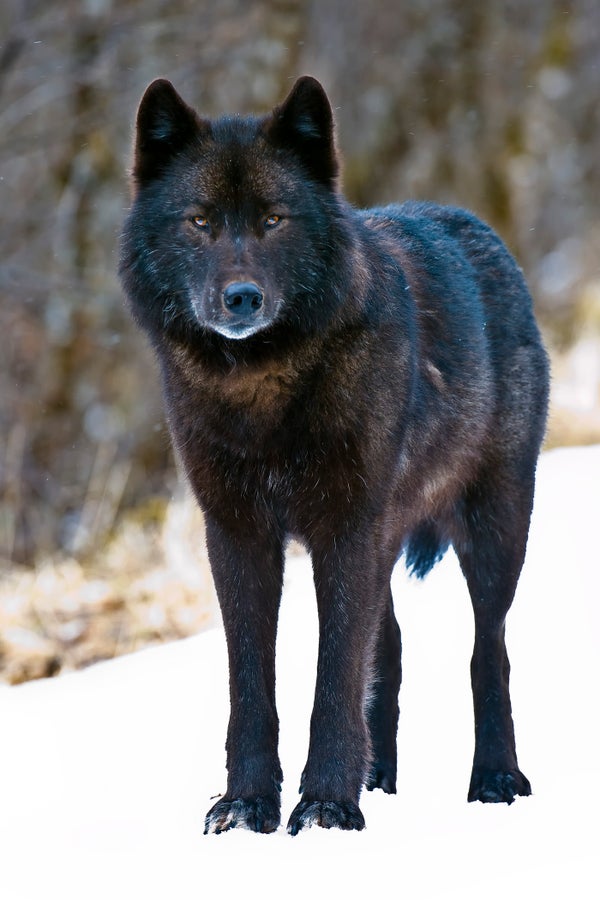
Photo © Robin Silver, courtesy of the Center for Biological Diversity
* Note (6/15/15): This article has been corrected to reflect the population decline on Prince of Wales and related islands. Alexander Archipelago wolves also exist on a few other islands and the nearby mainland.
Previously in Extinction Countdown: