Bat-Killing Fungus Spreads from Coast to Coast

The fungus that causes white-nose syndrome leapt over the Rockies and turned up in Washington State

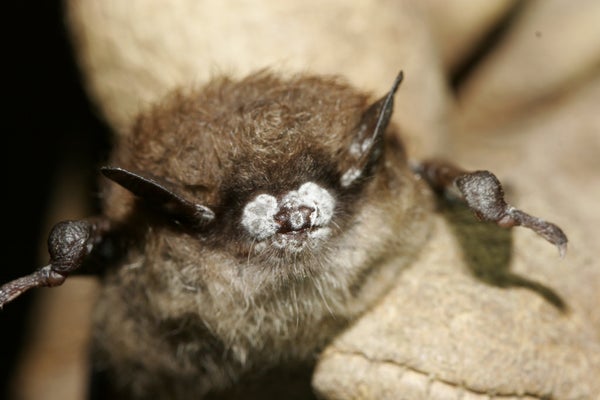
Photo: A little brown rate infected with white-nose syndrome, by Ryan von Linden/New York Department of Environmental Conservation

Join Our Community of Science Lovers!

This article was published in Scientific American’s former blog network and reflects the views of the author, not necessarily those of Scientific American


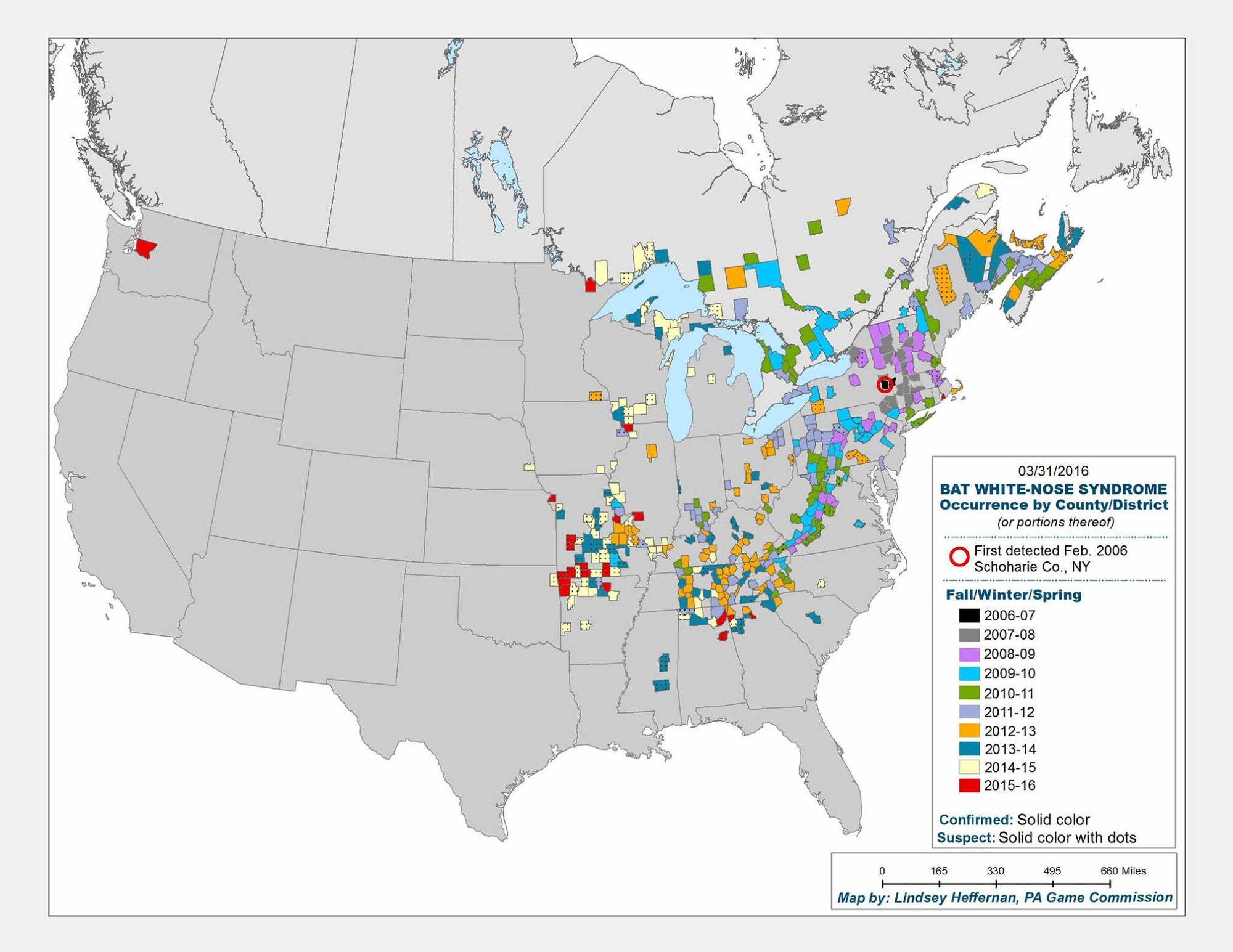
The discovery of a sick bat about 50 miles east of Seattle has revealed startling news: the fungus that has killed millions of bats in the eastern part of the country has leapt over the Rockies and arrived more than 2,000 kilometers to the west in Washington State.

The fungus, Pseudogymnoascus destructans, causes a usually fatal condition called white-nose syndrome, named after the fuzzy white growth that often appears on infected bats’ snouts. The fungus damages bats’ skin and wing tissues and interferes with their ability to hibernate. Affected bat colonies often experience mortality rates of 99 percent.

The fungus first turned up in 2006 and has since been blamed for the deaths of at least 6 million bats (that number hasn’t been updated since 2014, so it’s probably much higher by now). Its appearance in Washington came concurrently with its first observation in Rhode Island. You can follow its spread in this map released by the U.S. Fish and Wildlife Service:


On supporting science journalism

If you're enjoying this article, consider supporting our award-winning journalism by subscribing. By purchasing a subscription you are helping to ensure the future of impactful stories about the discoveries and ideas shaping our world today.

It’s unclear how the fungus spread to Washington, but experts have noted that it may be transmitted from cave to cave by traveling spelunkers. The FWS recently issued recommendations for anyone accessing subterranean bat roots in order to minimize the spread of the disease.

Previously in Extinction Countdown:

John R. Platt is the editor of The Revelator. An award-winning environmental journalist, his work has appeared in Scientific American, Audubon, Motherboard, and numerous other magazines and publications. His "Extinction Countdown" column has run continuously since 2004 and has covered news and science related to more than 1,000 endangered species. John lives on the outskirts of Portland, Ore., where he finds himself surrounded by animals and cartoonists.

More by John R. Platt

It’s Time to Stand Up for Science

If you enjoyed this article, I’d like to ask for your support. Scientific American has served as an advocate for science and industry for 180 years, and right now may be the most critical moment in that two-century history.

I’ve been a Scientific American subscriber since I was 12 years old, and it helped shape the way I look at the world. SciAm always educates and delights me, and inspires a sense of awe for our vast, beautiful universe. I hope it does that for you, too.

If you subscribe to Scientific American, you help ensure that our coverage is centered on meaningful research and discovery; that we have the resources to report on the decisions that threaten labs across the U.S.; and that we support both budding and working scientists at a time when the value of science itself too often goes unrecognized.

In return, you get essential news, captivating podcasts, brilliant infographics, can't-miss newsletters, must-watch videos, challenging games, and the science world's best writing and reporting. You can even gift someone a subscription.

There has never been a more important time for us to stand up and show why science matters. I hope you’ll support us in that mission.

Thank you,

David M. Ewalt, Editor in Chief, Scientific American

Subscribe