
This article was published in Scientific American’s former blog network and reflects the views of the author, not necessarily those of Scientific American
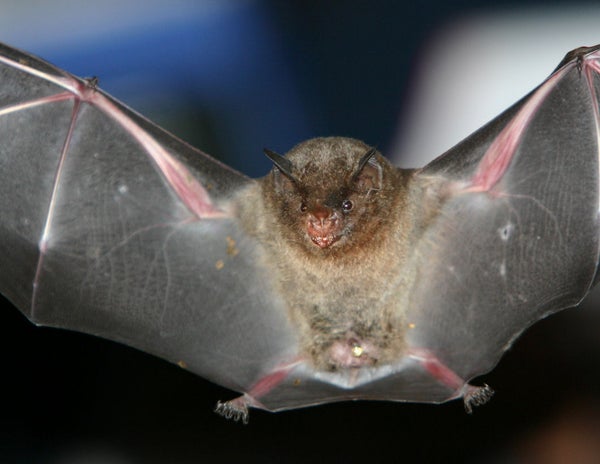
When it comes to bats, location matters as much as echolocation. New research reveals that dozens of Brazil’s unique bat species will soon face a major habitat crunch due to a combination of climate change and deforestation. If the bats don’t have the ability to move to new habitats, some of their ranges could nearly disappear by the year 2050.
The study, published recently in the journal Global Ecology and Conservation, examined how climate change will affect bat habitat in Brazil’s Cerrado tropical savanna ecoregion. The Cerrado has been called one of the most biodiversity-rich areas on the planet, and its bats are no exception. At least 118 bat species can be found within the Cerrado—more than 10 percent of all bat species on the planet.
The news for these unique species, most of which have very specific habitat requirements, wasn’t good. The researchers, from Universidade de Brasilia and other institutions, found that climate change will require Brazil’s bats to move an average of 281 kilometers to new habitats if they are going to survive in a warming world.
On supporting science journalism
If you're enjoying this article, consider supporting our award-winning journalism by subscribing. By purchasing a subscription you are helping to ensure the future of impactful stories about the discoveries and ideas shaping our world today.
Unfortunately, that movement won’t be easy. The Cerrado has been heavily deforested over the past several decades to make way for agricultural development such as soybean, coffee and sugarcane plantations. According to the paper only 20 percent of the region’s vegetation remains undisturbed. Lack of appropriate habitat means many of Brazil’s bats will not be able to slowly shift the places in which they live in order to reach their new, optimal habitats by the year 2050.
With no ability to disperse, the researchers calculated that 36 bat species will end up losing more than 80 percent of their suitable habitat. Of those, five species will be hit the worst. According to the paper the Thomas’s nectar bat (Hsunycteris thomasi), Peter’s disk-winged bat (Thyroptera discifera), greater yellow-shouldered bat (Sturnira magna), Tilda’s yellow-shouldered bat (S. tildae) and great stripe-faced bat (Vampyrodes caraccioli) will face habitat reduction of more than 98 percent, enough to make the species unviable in the Cerrado.
None of these five species are currently considered endangered. Luckily some of them have wide ranges and exist outside the Cerrado, but this type of habitat loss could easily isolate disparate populations or even threaten the future for entire species.
At least a portion of this habitat constriction could be avoided. The researchers have mapped out a series of migration corridors that could allow the bats to move to their new habitats. If the corridors are saved from further deforestation and destruction, the bats could shift their locations more easily. This, they write, could allow most of the bats to adapt to climate change and save the majority of the species from feeling the squeeze.
Previously in Extinction Countdown: