
This article was published in Scientific American’s former blog network and reflects the views of the author, not necessarily those of Scientific American
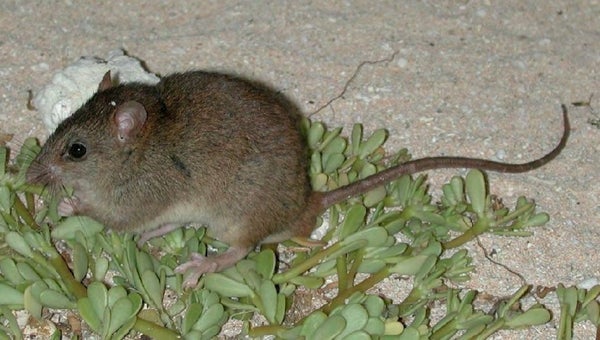
Climate change has claimed its first confirmed mammal extinction. The tiny Bramble Cay melomys (also known as the Bramble Cay mosaic-tailed rat, Melomys rubicola) has been declared extinct by the government of Queensland, Australia after an exhaustive search failed to turn up any evidence of its continued existence.
The Bramble Cay melomys lived in just a single habitat, a small reef island at the northern tip of the Great Barrier Reef. The sandy cay—which only measures 340 meters by 150 meters—has been repeatedly buffeted by storm surges from extreme weather events over the past decade, wiping out about 97 percent of its vegetation. High tides now cover the majority of the entire island. With nothing to eat and few places left to escape the ocean, the melomys appears to have now disappeared.
According to the report, the last person to see the Bramble Cay melomys alive was a professional fisherman, who spotted one of the rodents in late 2009.
On supporting science journalism
If you're enjoying this article, consider supporting our award-winning journalism by subscribing. By purchasing a subscription you are helping to ensure the future of impactful stories about the discoveries and ideas shaping our world today.
This extinction actually doesn’t come as much of a surprise. The Bramble Cay melomys was once described as relatively common. By the end of the Twentieth Century that was no longer the case. A survey in 1998 estimated the population at just 93 individuals, down from “hundreds” two decades earlier. Surveys in 2002 and 2004 turned up just 10 and 12 of the rats, respectively, according to a 2008 recovery plan for the species. That plan called out sea-level rise, flooding and coastal erosion as potential threats.
Those threats, all inspired by global warming, do appear to have caused the extinction of the Bramble Cay melomys. A report from researchers with the Queensland Department of Environment and Heritage Protection and the University of Queensland identifies “human-induced climate change [as] the root cause of the loss of the Bramble Cay melomys.”
Despite the bad news, the researchers say there’s still a sliver of hope for the Bramble Cay melomys. There’s a remote possibility that it, or related species, may still exist on other islands, which have not yet been surveyed, or even on nearby Papua New Guinea, where mammal biodiversity is poorly studied.
Meanwhile, the deterioration of Bramble Cay itself continues, a situation that could threaten several seabird species as well as the green turtles that nest there. The researchers recommend looking into “cost-effective actions to prevent future losses” for those important species.