
This article was published in Scientific American’s former blog network and reflects the views of the author, not necessarily those of Scientific American
Will an endangered flower named after musician Jimi Hendrix fade into the purple haze of memory?
Not if the researchers who just discovered it have anything to say about it. They hope that the announcement of this new but endangered species will mobilize efforts to protect and conserve the remote region of Baja, Mexico, in which it and other rare plants are found.
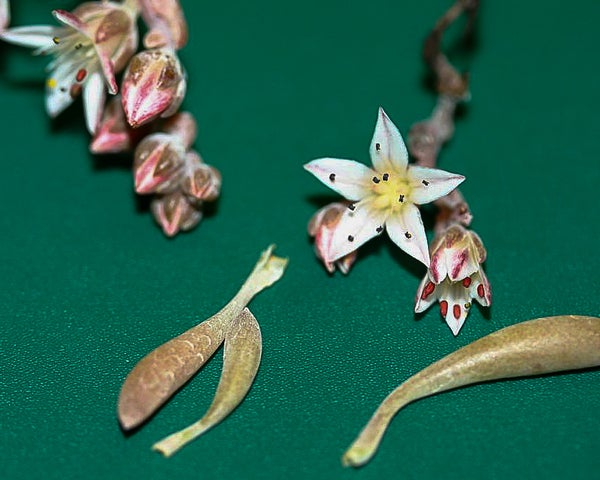
The researchers—who have dubbed the tiny new plant Hendrix’s liveforever or Dudleya hendrixii—say it is in particular need of conservation. “We estimated there were 5,000-10,000 plants on a few acres, perhaps 2-3 acres total,” says Stephen McCabe, a researcher with the Environmental Studies Department and Emeritus Director of Research at the Arboretum at the University of California Santa Cruz, one of the authors of a paper describing the new species in the journal Madroño. McCabe and his co-authors say the site, part of the “botanists’ paradise” known as Colonet Mesa, faces threats from farming and livestock grazing and could also face the risk of future development.
On supporting science journalism
If you're enjoying this article, consider supporting our award-winning journalism by subscribing. By purchasing a subscription you are helping to ensure the future of impactful stories about the discoveries and ideas shaping our world today.
Dudleya species in general, McCabe points out, are hardy plants—they don’t “live forever” as their name would imply, although they can survive uprooted without water for a year or more—but the new species’ restricted range makes it particularly vulnerable. The researchers warn that the site could easily be damaged or even completely destroyed, like castles made of sand, by an off-road vehicle or tractor.
The tiny, two-inch flower itself doesn’t immediately bring Jimi Hendrix to mind, but it’s not all about appearances. It turns out that the researcher who first encountered the plant at Colonet Mesa, Mark Dodero of RECON Environmental, was listening to the song “Voodoo Child” when he made the discovery.
That experience led McCabe, who saw Hendrix perform at the Santa Clara County Folk Rock Festival in 1969, to suggest the name, something he hopes will bring this rare flower—and maybe other plants along with it—some much-needed attention. “Cute animals easily get publicity, but it is trickier for plants,” McCabe says. “We have to be clever to get attention about plants. Getting people to even register that they exist is the first step in getting people to appreciate the liveforevers and some of our other rare plant species.”
That recognition can’t come soon enough. Right now, McCabe says just one organization, a nonprofit called Terra Peninsular, is working to protect the Colonet Mesa region. He hopes the Hendrix’s liveflower announcement will help them in their efforts to acquire land in the area for conservation purposes, as well as in his own efforts to identify other new species from the region.
Will Dudleya hendrixii continue to exist as long as its namesake’s memory? As with any endangered species, there “ain’t no telling” what the future brings, but McCabe hopes that the plant will persist. “Jimi Hendrix was one of a number of musicians concerned about what people were doing to the environment,” he says. Maybe, with that “bold as love” legacy in mind, the rock legend’s place in our culture will help to protect these rare plants for as many years as Hendrix’s music continues to play.