
This article was published in Scientific American’s former blog network and reflects the views of the author, not necessarily those of Scientific American
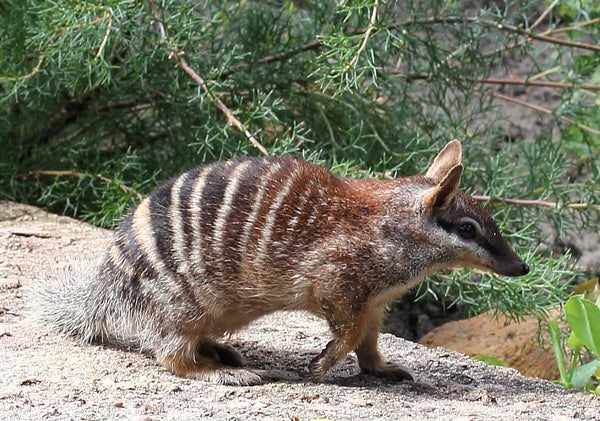
Feral cats have scratched up another victim. Earlier this month the Western Australia (WA) government listed a rare marsupial called the numbat, also known as the banded anteater (Myrmecobius fasciatus), as endangered. The colorful squirrel-like critters—literally the emblem of Western Australia—only grow to about 45 centimeters in length and have no defense against hungry felines.
As a result of this predation, the wild population of numbats—which only live in the state of WA—has fallen to an all-time low of about 1,000. Surveys conducted earlier this year found the animals now have a population density of just 0.24 animals per 100 square kilometers. That’s pretty darned low.
Conserving numbats has so far relied on two distinct programs. The first involves baiting and killing another invasive species, red foxes (Vulpes vulpes), which were introduced to Australia nearly two centuries ago and have been linked to other extinctions. WA Environment Minister Albert Jacob announced that state agencies will now step up its fox poisoning program and expand it to include cats. “Control of feral cats is one of our biggest challenges in protecting our threatened animal species,” he said in a prepared statement. The program uses a recently approved concoction called Eradicat, which was developed in WA and contains a mix of kangaroo mince, chicken fat and a deadly poison called 1080.
On supporting science journalism
If you're enjoying this article, consider supporting our award-winning journalism by subscribing. By purchasing a subscription you are helping to ensure the future of impactful stories about the discoveries and ideas shaping our world today.
The other program is more positive: captive breeding. Perth Zoo has the world’s only numbat captive breeding program and so far more than 200 of the animals have been released back into the wild to supplement the remaining populations. Last month 15 numbats—10 juveniles and five adults—wearing radio collars were released into an area called the Dryandra Woodland. Ten more were released into the same region on December 7. A conservation organization called Project Numbat helped to raise the money for the radio collars.
Despite their risks, numbats are doing better than some other species. The same day the numbat was declared endangered four other long-lost mammals were finally identified as extinct: the desert bettong (Bettongia ogilbyi penicillata), inland burrowing bettong (Bettongia lesueur graii), south-western rufous hare-wallaby ( Lagorchestes hirsutus hirsutus) and Gould's mouse (Pseudomys gouldii). All were probably wiped out by invasive predators like foxes, cats, mice or rats. None of them have been seen for at least 50 to 100 years.
Photo by S J Bennett. Used under Creative Commons license
Previously in Extinction Countdown: