
This article was published in Scientific American’s former blog network and reflects the views of the author, not necessarily those of Scientific American
It’s not easy to study the tiny Arctic seabird known as the ivory gull (Pagophila eburnea).
“They live in some of the most remote regions of the Arctic,” says Olivier Gilg with the University of Burgundy. Researching the species requires traveling to areas that are bitterly cold, dizzyingly high, and often dangerously full of hungry polar bears.
That hasn’t stopped Gilg and other researchers from studying these breathtakingly beautiful birds. A new paper by a team of international scientists presents what may be the clearest picture of the ivory gull’s migration and use of sea ice. Unfortunately, the news isn’t good.
On supporting science journalism
If you're enjoying this article, consider supporting our award-winning journalism by subscribing. By purchasing a subscription you are helping to ensure the future of impactful stories about the discoveries and ideas shaping our world today.
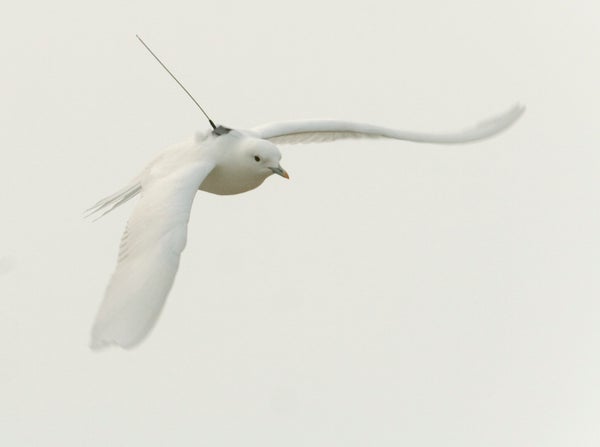
Gilg and his team used Argos satellite transmitters to track 104 ivory gulls between 2007 and 2013. The data they collected, published this month in Biology Letters, reveals that ivory gulls rely almost exclusively on the thickest, most concentrated sea ice during their breeding season. That happens to be the same type of ice that is already becoming rarer due to the effects of climate change.
The study also revealed that the birds, which feed almost exclusively on the ice edge, often had to travel as much as 100 kilometers from their breeding colonies to find food—quite a cost for a small bird that needs to feed every two days or so. “It’s not like a big marine mammal that can fast for a few weeks,” Gilg says.
The news follows an August study which found that the Canadian population of ivory gulls has fallen 80 percent over the past 30 years and two studies from 2015 which found potentially dangerous levels of methyl mercury in the birds’ systems, including the highest levels of the toxic metal in the eggs of any Arctic bird species. Arctic gulls often scavenge large carcasses left by polar bears, leaving them particularly vulnerable to toxins that travel up the food chain into top predators.
Will the ivory gull be able to adjust its behavior to survive these threats? That remains the open question about the species. Gilg, who is also president of Groupe de Recherche en Ecologie Arctique, says he wonders what may happen to the species over the next 20 to 50 years. “They may disappear,” he admits.
Although the birds are considered endangered in most of the countries in which they are found, international bodies such as the IUCN still consider them to be “near threatened.” Gilg says he suspects that may change in the coming year. What comes after that will require more study—something that will remain difficult, but which suddenly feels much more important.