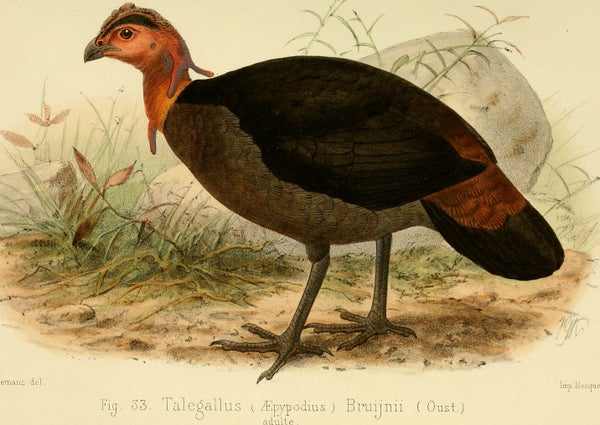
Thanksgiving Species Snapshot: Waigeo Brush-Turkey

Once thought to be extinct, this rare turkey lives on a remote Indonesian island where few people have ever seen it, let alone eaten it

Join Our Community of Science Lovers!

This article was published in Scientific American’s former blog network and reflects the views of the author, not necessarily those of Scientific American


Species name: The Waigeo brushturkey, aka the Bruijn's brushturkey (Aepypodius bruijnii)

Where found: The rugged, windy mountains of Waigeo Island, part of West Papua in Indonesia. The island is also home to several other endemic species, including the golden-spotted tree monitor (Varanus boehmei) and Waigeo cuscus (Spilocuscus papuensis).

IUCN Red List status: The species was previously believed to be extinct until it was rediscovered in 2002. Now it’s considered to be Endangered. Fewer than 1,000 of these large turkeys are thought to exist, all living in small population pockets.


On supporting science journalism

If you're enjoying this article, consider supporting our award-winning journalism by subscribing. By purchasing a subscription you are helping to ensure the future of impactful stories about the discoveries and ideas shaping our world today.


Major threat: The small population size makes this species particularly threatened, but hunting, habitat loss, fire and rogue dogs also contribute to its risk factors. Luckily these birds nest in the highest, remotest, least accessible mountains, making them fairly safe, although that also makes it hard for the turkeys to find each other.

Notable conservation programs: None, although about half of Waigeo is a currently set aside under the Cagar Alam Waigeo Barat Nature Reserve, effectively protecting these birds from threats such as logging and mining. Whether the Waigeo brushturkey continues to avoid those threats in the future, as more and more Indonesian islands get mined for their valuable minerals, remains to be seen.

John R. Platt is the editor of The Revelator. An award-winning environmental journalist, his work has appeared in Scientific American, Audubon, Motherboard, and numerous other magazines and publications. His "Extinction Countdown" column has run continuously since 2004 and has covered news and science related to more than 1,000 endangered species. John lives on the outskirts of Portland, Ore., where he finds himself surrounded by animals and cartoonists.

More by John R. Platt

It’s Time to Stand Up for Science

If you enjoyed this article, I’d like to ask for your support. Scientific American has served as an advocate for science and industry for 180 years, and right now may be the most critical moment in that two-century history.

I’ve been a Scientific American subscriber since I was 12 years old, and it helped shape the way I look at the world. SciAm always educates and delights me, and inspires a sense of awe for our vast, beautiful universe. I hope it does that for you, too.

If you subscribe to Scientific American, you help ensure that our coverage is centered on meaningful research and discovery; that we have the resources to report on the decisions that threaten labs across the U.S.; and that we support both budding and working scientists at a time when the value of science itself too often goes unrecognized.

In return, you get essential news, captivating podcasts, brilliant infographics, can't-miss newsletters, must-watch videos, challenging games, and the science world's best writing and reporting. You can even gift someone a subscription.

There has never been a more important time for us to stand up and show why science matters. I hope you’ll support us in that mission.

Thank you,

David M. Ewalt, Editor in Chief, Scientific American

Subscribe