
This article was published in Scientific American’s former blog network and reflects the views of the author, not necessarily those of Scientific American
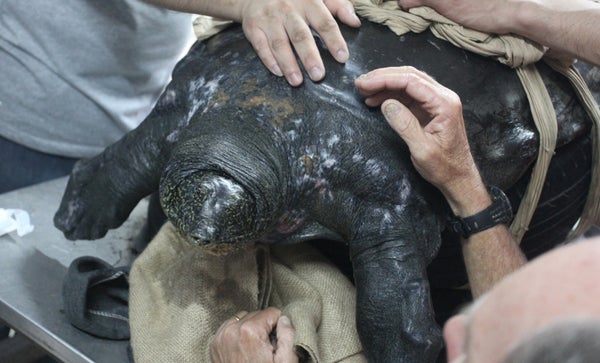
Two months ago the world’s conservationists crossed their collective fingers and waited to find out if a 100-year-old female Yangtze giant softshell turtle (Rafetus swinhoei), the last of her gender, would—after artificial insemination—finally lay fertile eggs and save her species from extinction.
I’m sorry to say that those hopes have, at least temporarily, been dashed. The Turtle Survival Alliance reported this week that the centenarian did lay 89 eggs, but all were infertile.
That doesn’t mean the quest is over, however. The female is expected to lay one or two more clutches of eggs this year. They’ll try to inseminate here again before then.
On supporting science journalism
If you're enjoying this article, consider supporting our award-winning journalism by subscribing. By purchasing a subscription you are helping to ensure the future of impactful stories about the discoveries and ideas shaping our world today.
First, though, researchers need to learn more about softshell turtle reproduction. That’s been a big challenge. “We’re flying blind here,” says Turtle Survival Alliance (TSA) president Rick Hudson. “We’re kind of learning as we go.”
You see, turtle reproduction isn’t as simple as “insert tab A into slot B.” It’s rather involved and involves organs that are much more complicated than seen in humans. “Male softshell turtles have one of the most complex reproductive organs we know of,” Hudson says. “It’s a bizarre-looking appendage with multiple tentacles and it’s just a huge, horrible looking thing. It’s that way for a reason. All of those appendages and things that come off them must fit inside the female softshell turtle’s anatomy somehow. And we don’t know what that is.” (For more on male turtles’ sex organs, check out Tetrapod Zoology here on SciAm Blogs.)
For a better view, the TSA’s reproductive expert, Gerald Kuchling, has been looking at female softshell turtles of other species. “You fill the cloaca with water or air. Then you can go in with an endoscope and look around,” Hudson explained. “You can see what that internal anatomy looks like. Hopefully through that you can kind of pinpoint better where you might want to direct the artificial insemination next time.” He says the information they’ve learned so far should help them the next time they try to inseminate the female.
The other big challenge is figuring out the other end of the equation: how to handle, transport, store, freeze and reconstitute turtle semen. The male they’re using is also about 100 years old, so as Monty Python says, every sperm is sacred. Figuring out how to preserve the semen will not only help with future insemination attempts but also to store genetic material for the future. Hudson says they’re also conducting trials on that with captive softshell turtles in Australia.
Only four giant softshell Yangtze turtles remain: a male and female in China and two males in Vietnam. We still hope for the pitter-patter splash of little flippers, but for now the waiting game continues.
Photo: Lu Shunqing/Wildlife Conservation Society