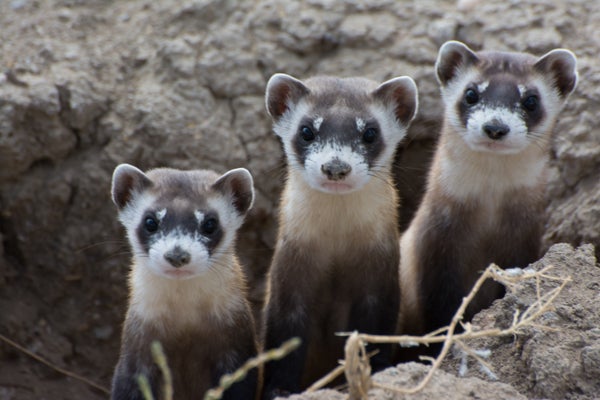
What A Special Black-Footed Ferret Can Teach Us about Conservation Success

When a species is critically endangered, every individual matters

Join Our Community of Science Lovers!

This article was published in Scientific American’s former blog network and reflects the views of the author, not necessarily those of Scientific American


Visitors to the Fort Collins Museum of Discovery in Colorado can get a chance to meet a rock star of the wildlife world: a black-footed ferret named Stevie Nicks.

Named after singer Stevie Nicks, this cute and ferocious little carnivore is part of the captive-breeding and release program that has saved her species. Today more than 1,400 black-footed ferrets live in the wild—a major success for a species that was believed to be extinct just 30 years ago.

Unfortunately, Stevie can’t be released to live in the wild—she’s blind, so she could never survive on her own.


On supporting science journalism

If you're enjoying this article, consider supporting our award-winning journalism by subscribing. By purchasing a subscription you are helping to ensure the future of impactful stories about the discoveries and ideas shaping our world today.


But she’s still part of the breeding program, and as a resident of the museum she helps her species by serving as a public face of the extinction crisis. From her safe enclosure, she can inspire visitors who get the rare opportunity to see a live black-footed ferret play and even hunt whenever her keepers give her live rodents.

Black-footed ferrets aren’t out of the woods yet. They still face threats from habitat loss and sylvatic plague and other diseases, but hardworking conservationists have managed to save them from disappearing forever.

Learn more about Stevie and black-footed ferrets in our video below.

This post first appeared on The Revelator on January 22, 2020.

John R. Platt is the editor of The Revelator. An award-winning environmental journalist, his work has appeared in Scientific American, Audubon, Motherboard, and numerous other magazines and publications. His "Extinction Countdown" column has run continuously since 2004 and has covered news and science related to more than 1,000 endangered species. John lives on the outskirts of Portland, Ore., where he finds himself surrounded by animals and cartoonists.

More by John R. Platt

It’s Time to Stand Up for Science

If you enjoyed this article, I’d like to ask for your support. Scientific American has served as an advocate for science and industry for 180 years, and right now may be the most critical moment in that two-century history.

I’ve been a Scientific American subscriber since I was 12 years old, and it helped shape the way I look at the world. SciAm always educates and delights me, and inspires a sense of awe for our vast, beautiful universe. I hope it does that for you, too.

If you subscribe to Scientific American, you help ensure that our coverage is centered on meaningful research and discovery; that we have the resources to report on the decisions that threaten labs across the U.S.; and that we support both budding and working scientists at a time when the value of science itself too often goes unrecognized.

In return, you get essential news, captivating podcasts, brilliant infographics, can't-miss newsletters, must-watch videos, challenging games, and the science world's best writing and reporting. You can even gift someone a subscription.

There has never been a more important time for us to stand up and show why science matters. I hope you’ll support us in that mission.

Thank you,

David M. Ewalt, Editor in Chief, Scientific American

Subscribe