
This article was published in Scientific American’s former blog network and reflects the views of the author, not necessarily those of Scientific American
Wolves are carnivores. Monkeys are made of meat. Monkeys, therefore, would seem to be a pretty good choice of prey for hungry wolves, right?
Not so fast.
It turns out that some monkeys make better hunting partners than prey. That’s the case on the Ethiopian highlands, where two unusual species have developed an equally unusual co-dependency. The relationship benefits both canine and primate, although at least one or two nearby rodent species might regret it.
On supporting science journalism
If you're enjoying this article, consider supporting our award-winning journalism by subscribing. By purchasing a subscription you are helping to ensure the future of impactful stories about the discoveries and ideas shaping our world today.
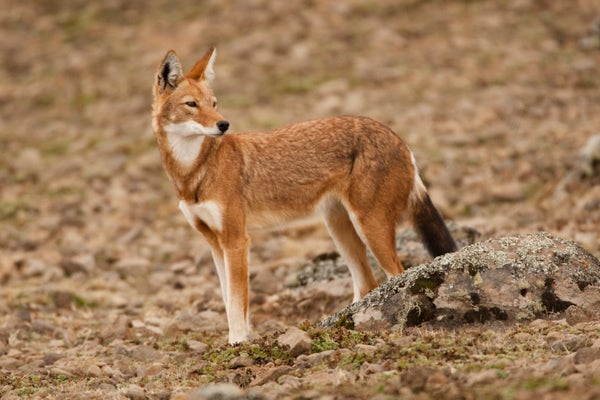
Here’s how it all works. According to research published recently in the Journal of Mammalogy, critically endangered Ethiopian wolves (Canis simensis) and a rare monkey species called the gelada (Theropithecus gelada) work extremely well together by just letting each other be. The gelada (which look like and are closely related to baboons) are herbivorous grazers; they walk around mountainous fields eating tasty grasses. Ethiopian wolves, meanwhile, carefully walk amongst the gelada herd. The gelada barely blinked an eye at the nearby predators because they knew the wolves aren’t interested in them.
Ethiopian wolves, you see, love rodents. They’re prey specialists and they rarely target anything other than the region’s several rat species, which normally hide underground. The gelada’s foraging activity apparently disturbs the rodents from their safe dens. As a result, the wolves end up with an easy meal.
How easy? According to researchers, wolves who hunted away from gelada managed to successfully nab a rodent meal about 25 percent of the time. When near gelada, however, that jumped to 68 percent. That’s a lot more full bellies for a lot less effort.
The behavior isn’t widespread, or at least not anymore. The researchers made their observations at the Gaussa Plateau, which holds the largest population of gelada and about 30 Ethiopian wolves (out of fewer than 500 remaining for the entire species). Lead researcher Vivek V. Venkataraman, a Ph.D. student at Dartmouth College, said they observed about 15 wolves walking and hunting amongst the gelada.
“I believe these interactions between geladas and wolves were once more widespread and common, as the historical range of these species was larger,” Venkataraman says. “In that sense it's a vanishing behavior. I think it is too uncommon now to find populations of wolves and geladas that overlap, and are habituated to the presence of people and researchers.” Even the Gaussa region is heavily studied; a team of researchers has been studying gelada there for the past 10 years.
Understanding this behavior could help to conserve both species. Ethiopian wolves are the most endangered canine species on the planet, with a highly fragmented population that remains heavily persecuted by livestock owners who fear for their flocks. Gelada, meanwhile, are currently listed as of “least concern” on the IUCN Red List, but Venkataraman says they may actually be closer to endangered. They, too, have highly fragmented and isolated populations, he says, thanks to agricultural development in the Afroalpine habitat.
Gelada and wolves also share a common enemy: domesticated dogs. The wolves catch fatal diseases from the dogs, while the dogs actively and indiscriminately kill the primates. “Domesticated dogs are the monkeys’ worst predators, these days,” Venkataraman says.
All of this needs more research. Venkataraman says some similar behavior has been observed when Ethiopian wolves walk among herds of domesticated cattle, but that hasn’t been studied as well. “This suggests the phenomenon might be more general,” he says. Understanding it, then, could be the key to helping to preserve the Ethiopian wolf while there’s still time to save them.
It wouldn’t hurt the gelada, either.
Ethiopian wolf photo by James Hopkirk. Gelada photo by Rod Waddington. Both used under Creative Commons license