
This article was published in Scientific American’s former blog network and reflects the views of the author, not necessarily those of Scientific American
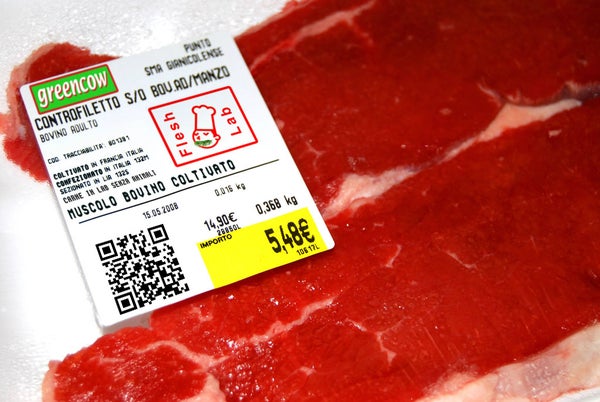
A few years ago Sergey Brin (one of the co-founders of Google) garnered a fair bit of media attention when he bankrolled and ate a synthetic hamburger made up of tissue grown in a lab from a few cells rather than harvested from a butchered animal. Most of the press I recall reading focused almost entirely on the price-tag: ~$250,000 for a single patty. Few humans can afford to spend a quarter of a million dollars on dinner, but if this sort of process can be scaled up and the price tag can come down, it would be be a massive leap forward for our species.
Never mind the massive ecological impact of meat production, or how increasing consumption by increasingly prosperous populous countries like India and China will make this worse. The way that we raise and kill animals in factory farms is ethically appalling when you stop to think about it. Most of us get away without thinking about it too much (I include myself in this category), but I don’t really think there’s a defensible argument to be made. I haven’t heard much about the Google effort in recent months, but on the podcast Waking Up, Sam Harris recently interviewed the CEO of a new company that’s trying to actually get in vitro meat to market.
On supporting science journalism
If you're enjoying this article, consider supporting our award-winning journalism by subscribing. By purchasing a subscription you are helping to ensure the future of impactful stories about the discoveries and ideas shaping our world today.
My only major gripe with the interview was the lack of push-back on the naturalistic fallacy. The CEO, Uma Valeti goes out of his way to defend against the notion that this sort of meat is “unnatural.” He wants to claim that this sort of meat is almost more natural than commercially grown meat, since it uses the same cells, but lab-cultured meat can avoid the heavy use of antibiotics, problems with fecal contamination and other health problems. And I can understand why he has to say this - we Americans are obsessed with all things natural…
But it’s patently absurd. Terrible food-borne pathogens like E. coli are perfectly natural, as are antibiotics and the evolution of antibiotic resistance. For most of human existence, we’ve been dealing with feces and our food sharing uncomfortably close quarters, and our omnivorous diets have involved messily slaughtering other animals. Natural ≠ Good, and Unnatural ≠ Bad. The “natural” way of getting calories from meat is inefficient, environmentally costly and pretty unethical. I’ll happily take some unnatural test-tube meat over that any day.