
This article was published in Scientific American’s former blog network and reflects the views of the author, not necessarily those of Scientific American
The global climate agreement reached in Paris late in 2015, which sets specific targets nations will aim for in limiting emissions of heat-trapping greenhouse, was widely and justly regarded as a diplomatic triumph.
But the accord never mentions the cryosphere, the frigid regions that include the planet’s polar ice caps; ice fields; mountain glaciers; and permafrost, or perennially frozen soil. Even if the emission-reduction targets are met, it won’t be enough prevent the cryosphere from thawing, tipping us into the sort of climate the world hasn’t seen in 30-50 million years, and certainly not since humans have existed.
A Planetary Freezer
On supporting science journalism
If you're enjoying this article, consider supporting our award-winning journalism by subscribing. By purchasing a subscription you are helping to ensure the future of impactful stories about the discoveries and ideas shaping our world today.
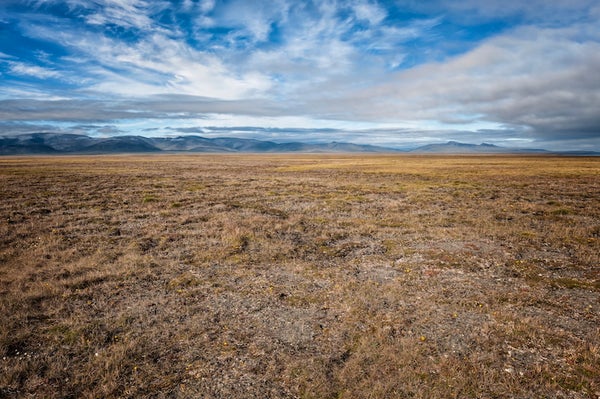
The crucial element in this scenario is permafrost, which is like a giant carbon deep-freeze. If we pull the plug on it by allowing it to thaw, plant matter that has been on ice for ages will decompose, and release carbon dioxide or methane or both into the atmosphere. Those gases will trap extra heat and raise global temperatures beyond what our fossil-fuel-based carbon emissions would do on their own.
The faster these gases emerge from the permafrost, the less carbon human society can release and still keep global temperatures from rising far above the aspirational temperature targets set by the Paris accord. The official goal of the agreement is to limit the increase in global average temperature to “well below 2°C above pre-industrial levels and to pursue efforts to limit the temperature increase to 1.5 °C ...”
But that official goal is unrealistic. Modeling by independent climate research groups has shown that the pledges outlined in the agreement would actually result in global average temperature gains of 2.7 °C to 3.5 °C by 2100, with an ultimate peak of 3.4 °C to 4.2 °C by the time Earth’s temperature stopped rising. And that doesn’t include the extra carbon now expected to be released from thawing permafrost. New calculations about the likely extent of those releases was simply too recent to incorporate into the accord.
What the Freezer Holds
“We know that the permafrost contains an enormous amount of carbon,” said Dr. Max Holmes, a senior climate scientist at the Woods Hole Research Center in Falmouth, MA. “Twice as much as in the atmosphere and three times as much as all vegetation on Earth.” The more quickly the carbon emerges, the greater the risk of triggering catastrophic climate change.
Models project that 30-70% of the world’s permafrost will thaw this century to a depth of about ten feet. Dr. Sue Natali, a colleague of Dr. Holmes at Woods Hole commented, “It’s going to be a slow release, not an explosion, and it’ll be faster after 2100.” “Once permafrost thaws,” she noted, “there’s no action we can take to stop the release of carbon,” she warned. Unlike temperature changes, cryosphere processes are typically irreversible.
Dr. Natali’s concern is underscored by a recent article in Nature Geoscience showing that the permafrost covering up to two-thirds of the terrestrial Arctic is degrading rapidly, causing major landscape and hydrology changes.
Meanwhile, a new survey of 98 permafrost experts in Environmental Research Letters indicates that we can’t count on the growth of new plants in the Arctic to offset permafrost carbon releases by absorbing carbon from the atmosphere, as some researchers had optimistically theorized. Instead, the permafrost region will become a source of extra carbon in the atmosphere by 2100, no matter what warming scenario the world follows.
On the bright side, the survey concluded that up to 85% of the permafrost-region carbon releases associated with a business-as-usual emissions scenario could be avoided, if net global emissions peaked within a decade or so, reached zero by around 2070, and became negative by 2100.
Our Carbon “Headroom”
The world’s permafrost stretches across 24 percent of the Arctic and contains 1.5 trillion tons of carbon. The permafrost could release as much as 130-160 billion tons of carbon just between now and 2100, according to a report from the International Cryosphere Climate Initiative (ICC). That would be roughly 100 times the carbon the U.S. annually emits from all fossil fuel and cement production.
Unlike emissions from fossil fuel combustion, emissions from thawing permafrost, in the form of methane and carbon dioxide, amplify themselves by causing extra warming that leads to even more thawing. In conjunction with society’s other emissions, the permafrost emissions could therefore lead to an out-of-control, self-reinforcing cycle of warming, thawing, further warming, and so on.
When permafrost emissions are included in the global allowable carbon “headroom” budget that the world can still in theory afford to emit and still stay below 2 °C of warming, then according to ICCI permafrost experts, the headroom for human emissions shrinks to only 115 billion tons of carbon, versus the 275 billion tons once presumed.
This means we have far less time to adjust our collective greenhouse gas emissions because we can now emit less than half as much additional carbon as we thought. We will have to act faster; transition costs to a clean energy economy will be higher; and our technological options will be fewer.
This is the first of two pieces about threats to the planet's cryosphere