
This article was published in Scientific American’s former blog network and reflects the views of the author, not necessarily those of Scientific American
On supporting science journalism
If you're enjoying this article, consider supporting our award-winning journalism by subscribing. By purchasing a subscription you are helping to ensure the future of impactful stories about the discoveries and ideas shaping our world today.
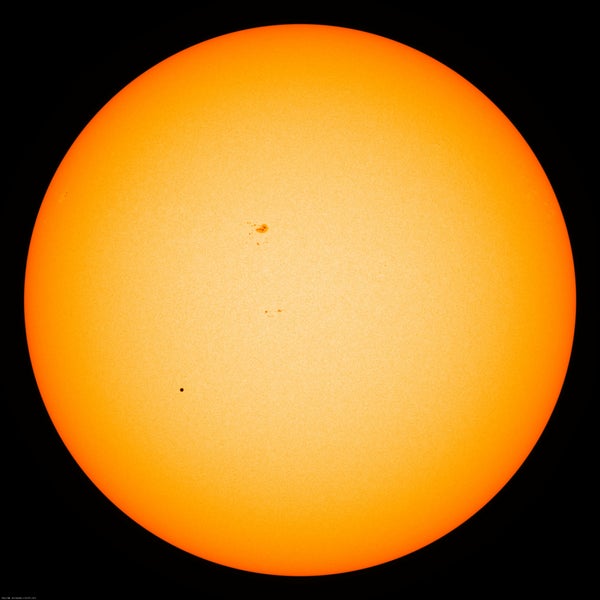
Today, Mercury made a seven-hour trek across the face of the Sun in a rare astronomical event known as a planetary transit. We can only observe the two inner planets in our solar system, Mercury and Venus, transit across the Sun. Mercury last made such a journey a decade ago: when smartphones weren’t yet popular, Al Gore debuted An Inconvenient Truth, and Pluto was still a planet.
We’ve come a long way since then. In 2006, it wasn’t possible to take ultra high-definition images—the kind we see on 4k TVs—of the Sun from space, but now a satellite called the Solar Dynamics Observatory (SDO) snaps such images every few seconds. In the image above, taken during the transit, the planet looks ridiculously small compared with the Sun—smaller than the size of an average sunspot—but the Earth would look only two and a half times larger. The movie below shows a string of SDO images (binned down to lower resolution so it fits on your screen) capturing Mercury as it traverses the solar disk.
Our innermost planet is an odd one: it takes only 88 Earth days to revolve around the Sun, but takes twice as long to rotate once. As a result, a Mercury day is twice as long as a Mercury year. Nevertheless, we only observe Mercury transits about 13 times a century. That’s because its orbit is inclined, or tilted, by seven degrees with respect to the Earth’s, so Mercury doesn’t usually intersect our line of sight to the Sun.