
This article was published in Scientific American’s former blog network and reflects the views of the author, not necessarily those of Scientific American
Albert Einstein is revered today as one of the most influential scientific minds of the 20th Century. His scientific theories have shaped our understanding of gravity, helped us understand how our universe works, and most importantly, laid the groundwork of modern physics as we know it. In fact, this year marks 100 years since Einstein, through his theory of general relativity, predicted the existence of gravitational waves. Our friends at LIGO indeed confirmed not once, but twice this year that black holes were capable of colliding, causing a ripple effect in the space-time fabric.
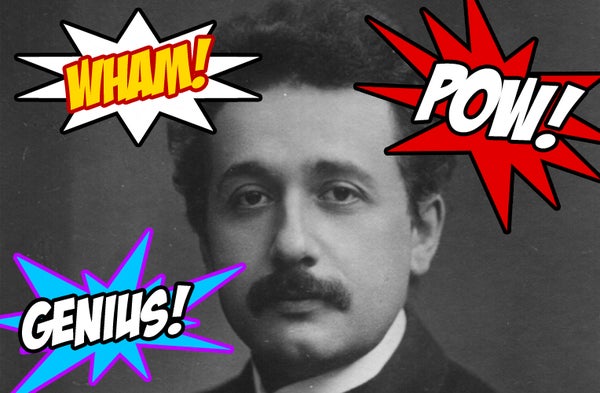
Putting aside Einstein’s science, the world’s favorite genius has consistently been a celebrity. In fact, Einstein famously said to his friends Max and Heidi Born in 1920, “Like the man in the fairytale who turned everything he touched into gold, so with me everything is turned into newspaper clamor.” Einstein has maintained his passing even 60 years after his passing. One way that Einstein’s celebrity status has been honored in pop culture is in the form of comic book cameos.
Albert Einstein has appeared in various comic books throughout the span of comic book history. Einstein’s first appearance in comic book lore came in DC Comics’ Superman #55, which published in 1948 featuring a two-page biography of Einstein titled “The Boy Who Wasn’t Too Bright.” Einstein’s next appearance in a comic book came in Marvel’s Amazing Adventures #5 in 1961, which only had a very brief cameo of Einstein but only as a flashback.
On supporting science journalism
If you're enjoying this article, consider supporting our award-winning journalism by subscribing. By purchasing a subscription you are helping to ensure the future of impactful stories about the discoveries and ideas shaping our world today.
Later DC and Marvel comic book issues would feature Einstein in more prominent cameo roles. Perhaps the most iconic are DC Comics Presents #69, where Einstein is held captive by Nazis with Clark Kent and creates a formula that “helps” Clark Kent obtain superhuman abilities, and Superman #416 “The Einstein Connection,” in which Lex Luthor mimics Einstein’s life on Einstein’s birthday; Superman later figures out that Lex Luthor does this because he admires Einstein. Historically, Einstein has been featured in more DC Comics stories than Marvel. Nevertheless, Einstein has a very rich history in the comic book universe.
Of course, the perfect marriage between Albert Einstein and comic book lore is the scientific derivation of many of these superheroes’ powers. For example, we can credit The Flash’s supersonic speed to Einstein’s theory of special relativity. Or even our understanding of wormholes in Einstein’s theory of general relativity paves a connection to Doctor Strange and his ability to travel to different dimensions thanks to the use of portals. It’s simply a no-brainer that the inherent scientific elements embedded in comic book stories would bear such a deep connection to Einstein’s theories and hypotheses. Who knows? Now with the discovery of gravitational waves, which Einstein predicted 100 years ago), comic book writers will find a way to pay homage to Einstein with the inclusion of such a theory in future comic book stories.
As a way to celebrate Einstein and the science of comic book superheroes, Lee Billings and Aaron Shattuck of Scientific American helped host a Facebook Live on the Albert Einstein Facebook Page talking precisely about this subject matter.