
This article was published in Scientific American’s former blog network and reflects the views of the author, not necessarily those of Scientific American
Salvador Dalí always thought of himself as a replacement for his older brother, who had died before the famous painter was born. Dalí’s theory is strengthened by the fact that his older brother had also been named Salvador. That’s creepy. We’re not certain if his art was a form of therapy, but it could explain some of his weird (and wonderful!) ideas. It is perhaps not surprising that double interpretations and images abound in Dali’s art. Our new Illusions column in Scientific American: Mind, out this month, focuses on Dalí’s Doubles.
The images below did not make it into the column due to space limitations. We include them here because they illustrate some of the ways in which Dali made old art new, while preserving the original image in his reinterpretation.

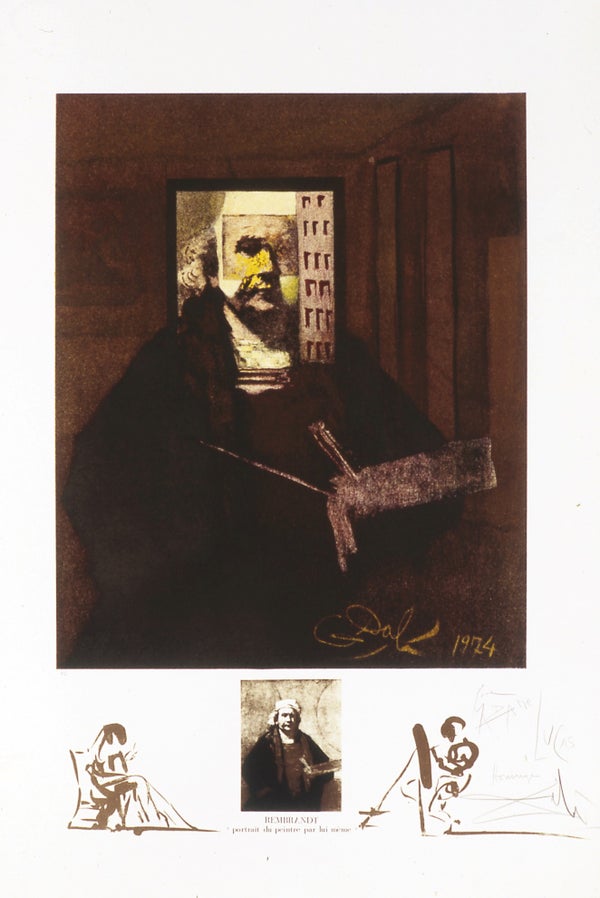
Left: Changes in Great Masterpieces, Rembrandt, by Salvador Dali. Lithograph, 1974. Right: Rembrandt’s original self-portrait.
On supporting science journalism
If you're enjoying this article, consider supporting our award-winning journalism by subscribing. By purchasing a subscription you are helping to ensure the future of impactful stories about the discoveries and ideas shaping our world today.
Dalí said that the sixteenth-century Italian painter Giuseppe Arcimboldo’s composite portraits of fruits and other objects inspired him to create double images in his own art. Whereas many of Arcimboldo’s portraits are examples of mosaicism, where a large object such as a hat is made up of smaller ones such as grapes and leaves, Dalí’s ambiguous images usually involve reversals of figure and background. In Changes in Great Masterpieces, Rembrandt (1974), Dalí saw an open door and receding dark hallway in the self-portrait of Rembrandt van Rijn (1606-1669). The viewer’s perception oscillates from Rembrandt’s portrait to the hallway picture, and back to the portrait again. Squinting one’s eyes helps to make the hallway the dominant scene, by blurring the details of the door and hallway. This peculiar switching of background elements and subject matter was popularized during the nineteenth- and twentieth-centuries by Gestalt psychologists, who attempted to understand perception as a whole, rather than as the sum of its parts.