

This article was published in Scientific American’s former blog network and reflects the views of the author, not necessarily those of Scientific American
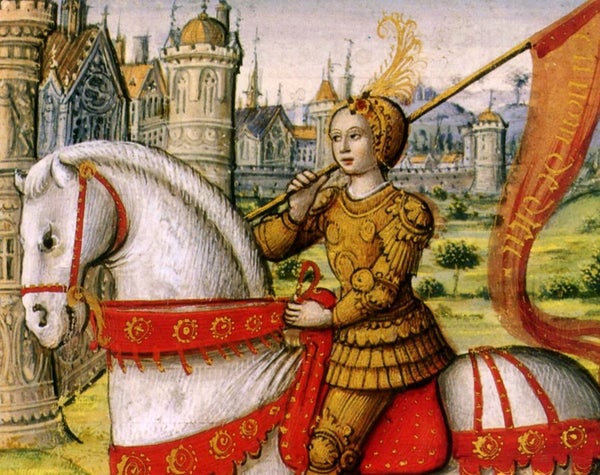
I went to David Byrne's play at The Public Theatre this weekend: "Joan of Arc: Into the Fire."
It was a visually sumptuous rock opera unlike any I have seen before.
Other rock operas—like The Who's "Tommy," ABBA's "Mamma Mia," or Queen's "We Will Rock You"—were fun. They were Broadway-musical-length live-action rock music videos. But, like MTV videos, they had weak storylines that served as visual background to the main event: the music. Byrne could have done something similar here—served up a medley of Talking Heads hits from their prodigious quiver of crowd-pleasers. Instead, he went a different way, bringing to bear his deep store of talent to tell the story of Joan of Arc. It was a completely original artistic tour de force. It set a new—very high—standard for the rock opera. It showcased a powerful and well-crafted narrative—following Joan of Arc's rise and fall—told with a completely new and excellent score by Byrne. I knew that Joan was a saint, a warrior, and perhaps—based solely on historical conjecture—was likely to have suffered from at least one neurological disease. But I hadn’t realized just how fascinating Ms. Of Arc’s life was, or how much deception played into both her rise and her fall.
On supporting science journalism
If you're enjoying this article, consider supporting our award-winning journalism by subscribing. By purchasing a subscription you are helping to ensure the future of impactful stories about the discoveries and ideas shaping our world today.
How do I describe the spectacle itself? It’s difficult. Like describing the difference in flavor between apples and chocolate cake without referring to food. Byrne’s show wasn't an avant-garde production, per se, despite his evident penchant for the weirdly wonderful. Rather, the entire production was fresh, captivating, and accessible to all. Joan of Arc had a linear storyline, but was nevertheless innovative in every way, from the bottom, up. And I mean the bottom. The stage itself was a fully interactive character in the play. The upstage (back) wall was a giant super-bright LED video monitor, which wrapped around the wings (sides) of the stage. It reached out along the walls of the proscenium and into the audience as if to give the viewers a big video hug. It drew me in. Fire—a thematic touchstone throughout the show—and other critical objects, scenery, surreal lighting, all conspired to set each scene of the play in what resulted in a highly dynamic production. A high-powered video projection moreover shined onto the stage from behind the audience, while they roamed the stage. The actors clearly must have worked within the constraints of a highly precise blocking design. This front cast movie projection added digital captions and narrative elements—in text and images—onto the stage and directly on the actors, throughout the story. Often, the video projector beamed onto the actors the same image that was shown on the wrap-around video stage, behind the actors, as if the actors were transparent—ephemeral wisps caught up in the tides of the historic events surrounding them. It was lovely and as close to augmented reality as one can get without wearing a VR headset.
The cast and musicians all gave outstanding performances (though I will otherwise leave the review of that aspect of the production to the professional theater critics).
Byrne raised my scientific interest with his choice of primary thread in Joan’s life narrative: deception. Every party on stage: Joan; the French royalty that she served at God’s behest; the Catholic church; the evil British overlords—all lied to each other, and they did it a lot. As a researcher of deception, I’m of course aware that everybody lies. But the story of Joan of Arc begins and ends in deception. She claimed communications with God—which I do not believe occurred (and even if it did, she partook in plenty of bullshitting throughout). She dressed as a man for various reasons and in various points of the story (which was against the law at the time) to hide her true identity. Her approach to the Dauphin (secret French king) was a trick. Her eventual betrayal by the French, the unkind and sexually-charged handling that she received by the British and Catholics, and of course her eventual trial and execution (which was itself a parade of trickery, strategy, and lies on both sides) were all based on lies. In the end, she burned at the stake for her claims that she acted on God’s wishes, and for dressing like a man. Claims based on deception (like getting Capone on taxes), and which Joan herself unsuccessfully attempted to defend with deception. Man, it was fascinating!
Byrne was remarkably sensitive to the implications of these events in our modern world. I thought the handling of the transgender undertones (on Joan's cross-dressing) were especially poignant given our country’s current identity crisis and our despicable current penchant for persecuting people with non-traditional gender identity. As if they did it just to annoy the bigoted.
I find myself returning to the production again and again, at multiple levels, and I hope you see it.