
This article was published in Scientific American’s former blog network and reflects the views of the author, not necessarily those of Scientific American
There is something deeply disconcerting about mirrors. The myriad reflecting surfaces that surround us in our everyday lives help us conduct many necessary tasks, such as applying makeup, shaving, or driving a car. But despite our constant use of mirrors, our nervous systems remain surprisingly ill-equipped to grasp the mechanics of refraction and reflection. Some magic tricks take advantage of such perceptual limitations, and are the origin of phrases such as “it’s all smoke and mirrors,” or “it’s all done with mirrors.”
Kokichi Sugihara, a mathematical engineer at Meiji University in Japan, has exploited our poor understanding of mirrors to create new and spectacular varieties of perceptual magic. Our May/June Illusions column features mirror-based illusions by Sugihara and others.
Here we provide you with step-by-step instructions to re-create some of Sugihara’s head-scratching mirror illusions with paper, glue and scissors.
On supporting science journalism
If you're enjoying this article, consider supporting our award-winning journalism by subscribing. By purchasing a subscription you are helping to ensure the future of impactful stories about the discoveries and ideas shaping our world today.

Credit: Kokichi Sugihara
The garage roof covering the little toy car changes shape when you look at its mirror reflection! In reality, it’s a trick of perspective. Build your own paper model of Sugihara’s ambiguous garage roof using the diagram above (you can print it from this template). Part A is the actual roof, and part B a support structure that will maintain the correct roof angles in the model. Cut around the outlines of A and B. There are three types of inner lines: solid lines depict mountain folds, dashed lines depict valley folds, and dash-dot lines show where to glue A and B together.
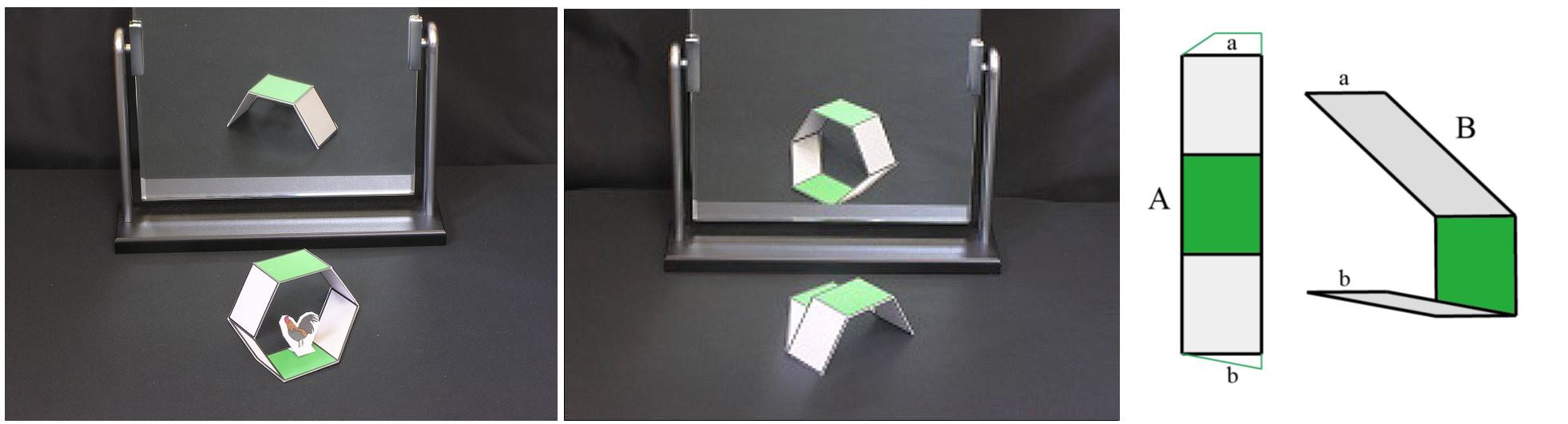
Credit: Kokichi Sugihara
How can you use a mirror to vanish half an object? To make your own half-disappearing hexagon, follow the diagram above (you can print it from this template). Part A is the upper half of the object, which you will need to fold along the two edges, forming 120-degree angles. Part B, or the lower half of the object, is a flat structure and should not be folded. Glue both parts together matching the “a” and “b” letters. For the strongest effect, tilt the mirror slightly downward.