
This article was published in Scientific American’s former blog network and reflects the views of the author, not necessarily those of Scientific American
Research has shown that the experience of pain is highly subjective: people feel more or less pain, in identical physical situations, as a function of their mood and attention. This flexibility showcases the potential for cognitive manipulations to decrease the pain associated with a variety of pathologies. As an example, the virtual-reality game “Snow World” (in which game in which players shoot snowballs to defeat snowman Frosty and his penguins) reportedly works better than morphine at counteracting the pain of patients in burn units. Other studies have indicated that virtual reality manipulations of the patient’s own body can also help ameliorate pain: an experiment conducted by neuroscientist Maria Victoria Sanchez-Vives and her team at the University of Barcelona in Spain showed that heat applied to experimental participants’ wrists felt more painful when their virtual arms turned red than when they turned blue or green.
Following on this tradition, a study published PeerJ last month showed that visuotactile illusions can help the pain experienced by patients suffering from knee osteoarthritis.
According to lead author Tasha Stanton, from the University of South Australia, the idea for the study originated from her observation that “people with knee osteoarthritis have an altered perception of their own body. [Their affected knee] often feels too big, and they also have changes to the way that touch and movement information is represented in the brain.” She hypothesized that patients may “respond to illusions that change the way their knee looks.”
On supporting science journalism
If you're enjoying this article, consider supporting our award-winning journalism by subscribing. By purchasing a subscription you are helping to ensure the future of impactful stories about the discoveries and ideas shaping our world today.
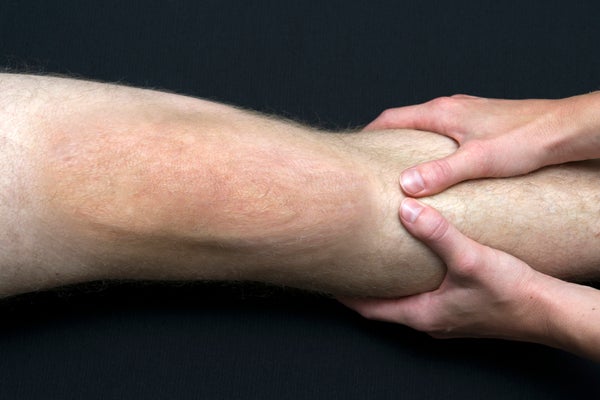
To find out, Stanton and her colleagues fit study participants with a head-mounted display and showed them a live video feed of their own knee. Then they used mediated reality (which alters one’s perception of reality with computer software) to generate two types of visuotactile illusion: one that produced the feeling of knee-stretching, and another that induced the feeling of knee-shrinking, allowing participants to see their own knee change in size, in real time. Simultaneously, the scientists applied gentle tactile pressure to the calf muscle, either pulling towards the foot or pushing towards the knee. Tactile stimulation could be either congruent (stretching video combined with tactile pulling, or shrinking video combined with tactile pushing) or incongruent (stretching video combined with tactile pushing, or shrinking video combined with tactile pulling) with the visual display.
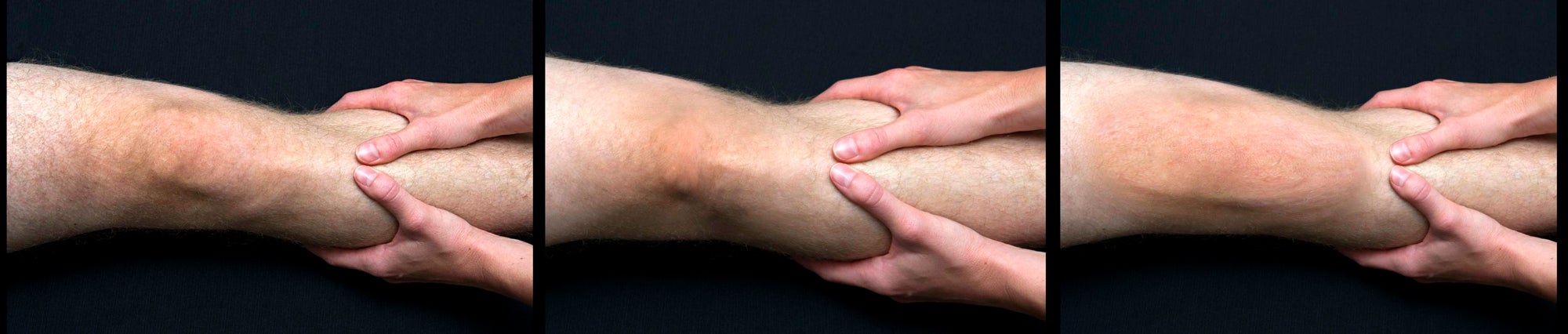
Illusory resizing of the knee: normal size, shrunk and stretched. Credit: Anne Graham, Neuroscience Research Australia
Third person perspective of the illusory knee resizing. Participants were asked to imagine they were looking at their own leg reflected in a large mirror placed in front of them. From Stanton TR, Gilpin HR, Edwards L, Moseley GL, Newport R. (2018) Illusory resizing of the painful knee is analgesic in symptomatic knee osteoarthritis. PeerJ 6:e5206 https://doi.org/10.7717/peerj.5206
Visuotactile illusions decreased pain by about 25%, but neither visual nor tactile stimulation, by itself, had analgesic value.
Surprisingly, both congruent and incongruent stimulation conditions were comparably effective, and there were significant individual differences concerning the type of illusion (stretching versus shrinking) that was most effective. A main conclusion of the study is that analgesia may not be achieved by visual information alone, but require multisensory input.
“We are looking to better understand the relationship between how our system codes for spatial aspects of pain (where you feel pain and how much it spreads) and the perceived size of the body,” says Stanton. “Do we calibrate our system based on the perceived (versus the actual) size of our body? We are using visual illusions that change the size of the limbs to see if we can alter spatial properties of pain merely through perceptual modulation.”