
This article was published in Scientific American’s former blog network and reflects the views of the author, not necessarily those of Scientific American
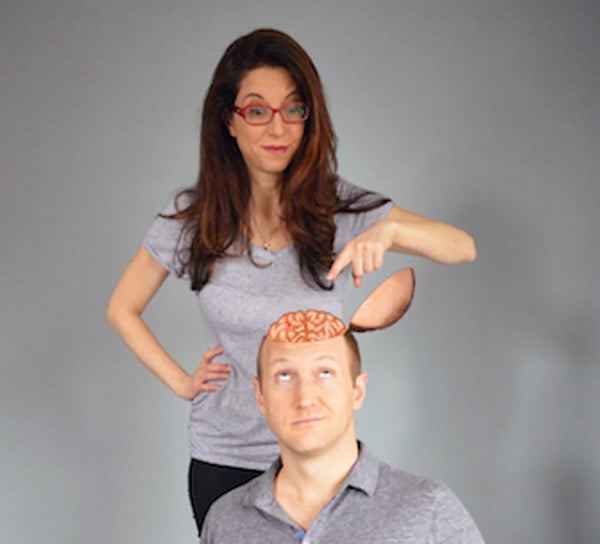
I had a great time on Wednesday night when Baba Brinkman—a professional rapper and science enthusiast—dropped knowledge at The Huron Club, downstairs in the Soho Playhouse, partnered by his neuroscientist spouse Heather Berlin, an Assistant Professor of Psychiatry at The Mount Sinai School of Medicine. Berlin hilariously described her findings about Brinkman’s brain-scanned neural inner workings—and defects—while she subjected him to impossible cognitive tasks in her lab, as he freestyled in multi-syllabic rhyme, to a phat beat. But it’s a love story too, because while Berlin was studying Brinkman as a research subject, she was also sizing him up as a potential mate. Or inevitable mate, in this case, as they now have two children. Or maybe accommodating Berlin’s research was Brinkman’s secret plan to get the girl. Charles Darwin himself would have been challenged to explain this form of sexual selection: Brinkman’s fitness display was revealed to be based on how loud his experimenter would laugh at his goofy spittin’ while simultaneously juggling lemons and freestylin’ Freudian slips. But it worked! Dawg is all smiles now, yo, cuz he got hisself his ideal scientific mate.
The grand finale of the show was Berlin spittin’ a rhyme. Her Oxford dons would have been proud, to be sure!
If you like neuroscience or rap, you should go. The show was entirely engaging and their guest comedian, Myq Kaplan was yet another highlight. I am inspired to rap my summary of the show:
On supporting science journalism
If you're enjoying this article, consider supporting our award-winning journalism by subscribing. By purchasing a subscription you are helping to ensure the future of impactful stories about the discoveries and ideas shaping our world today.
Homies were accurate and lyrical… but not rem-ed-i-al… all neuroscientifical, fixated on the sex-u-al. Who da man now, dawg? Yo!

Berlin and Brinkman, Off The Top, At The Huron Club, in the Soho Playhouse, Wednesday nights at 7:30pm. Credit: Heather Berlin and Baba Brinkman