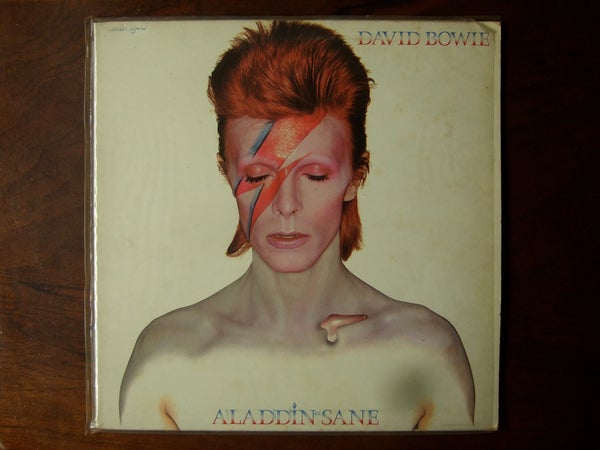
Remembering David Bowie: The Goblin King's Juggling Illusion

In memory of the artist David Bowie, who died on Sunday, January 10, we feature here an excerpt of the movie Labyrinth, with Bowie performing contact juggling as the Goblin King.


Join Our Community of Science Lovers!

This article was published in Scientific American’s former blog network and reflects the views of the author, not necessarily those of Scientific American


Magic performances usually require that the illusionist's hand and body motions appear casual and un-choreographed—but this is far from the truth. Indeed, magic and juggling require similar levels of practice and dexterity. There are many other connections, historical, social and cultural, between magic and juggling. Yet, one customary difference between both types of performance is that, whereas magic shows appear to defeat the physical laws of nature (objects appear and disappear, they levitate, they transmogrify), juggling shows demonstrate the skill of the performer in the face of gravity. Except perhaps for one particular modality of juggling, known as contact juggling. Here, there are no hidden moves, no contraptions, no smoke or mirrors. Everything happens the way it looks—but how things look seems impossible.         

In memory of the artist David Bowie, who died on Sunday, January 10, we feature here an excerpt of the movie Labyrinth, with Bowie performing contact juggling as the Goblin King. [In reality, Bowie did not juggle the crystal balls, but juggler Michael Moschen did it instead blindly, while hiding under Bowie's armpit. Real movie magic].


On supporting science journalism

If you're enjoying this article, consider supporting our award-winning journalism by subscribing. By purchasing a subscription you are helping to ensure the future of impactful stories about the discoveries and ideas shaping our world today.


Susana Martinez-Conde is a professor of ophthalmology, neurology, and physiology and pharmacology at SUNY Downstate Health Sciences University in Brooklyn, N.Y. She is author of the Prisma Prize–winning Sleights of Mind, along with Stephen Macknik and Sandra Blakeslee, and of Champions of Illusion, along with Stephen Macknik.

More by Susana Martinez-Conde

It’s Time to Stand Up for Science

If you enjoyed this article, I’d like to ask for your support. Scientific American has served as an advocate for science and industry for 180 years, and right now may be the most critical moment in that two-century history.

I’ve been a Scientific American subscriber since I was 12 years old, and it helped shape the way I look at the world. SciAm always educates and delights me, and inspires a sense of awe for our vast, beautiful universe. I hope it does that for you, too.

If you subscribe to Scientific American, you help ensure that our coverage is centered on meaningful research and discovery; that we have the resources to report on the decisions that threaten labs across the U.S.; and that we support both budding and working scientists at a time when the value of science itself too often goes unrecognized.

In return, you get essential news, captivating podcasts, brilliant infographics, can't-miss newsletters, must-watch videos, challenging games, and the science world's best writing and reporting. You can even gift someone a subscription.

There has never been a more important time for us to stand up and show why science matters. I hope you’ll support us in that mission.

Thank you,

David M. Ewalt, Editor in Chief, Scientific American

Subscribe